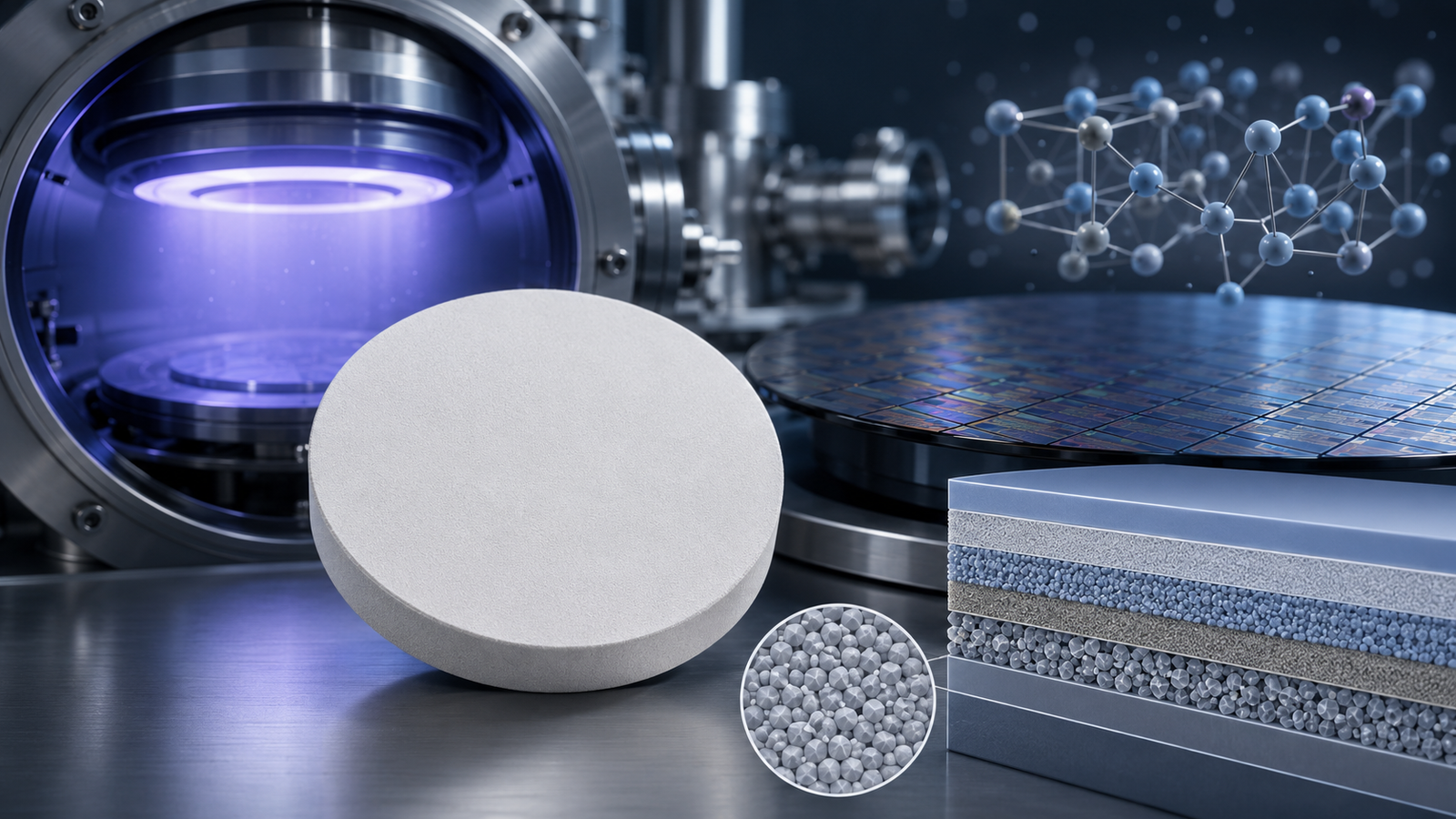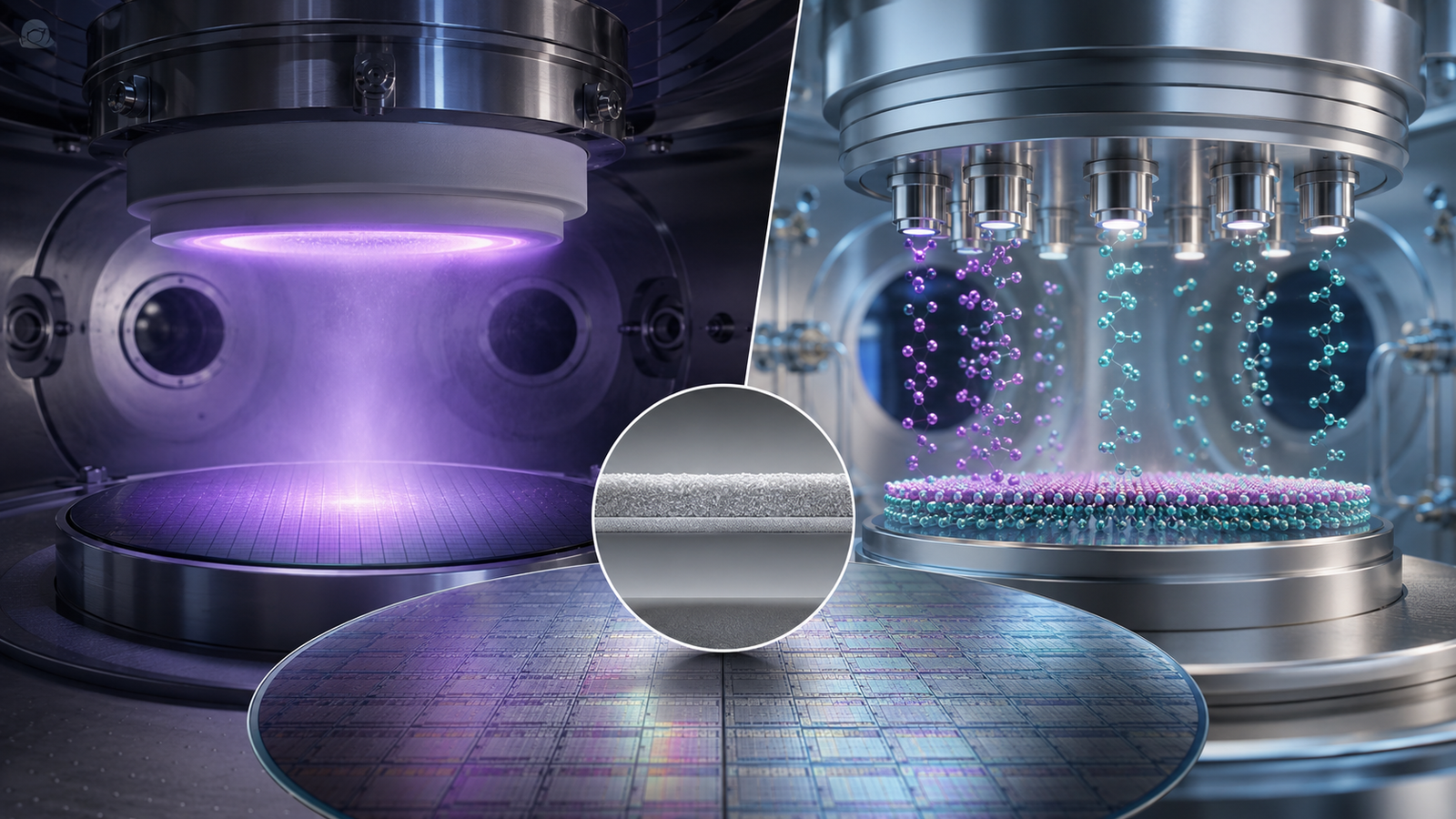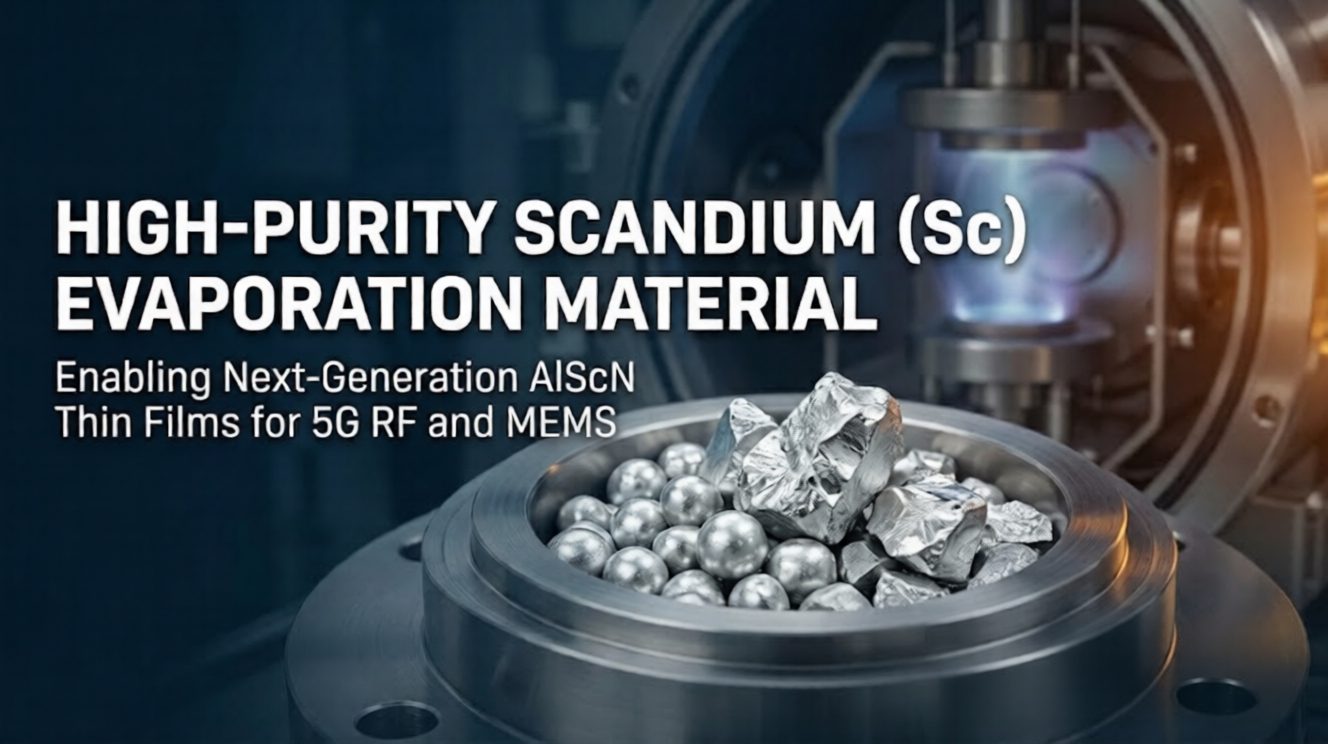
In the relentlessly advancing fields of microelectronics, telecommunications, and advanced energy systems, the demand for novel materials with extraordinary properties has never been higher. Among the elements transitioning from niche laboratory curiosity to high-volume commercial necessity, Scandium (Sc) stands out. Specifically, high-purity Scandium evaporation materials have become the cornerstone of next-generation Physical Vapor Deposition (PVD) processes.
The catalyst for this surge in demand is the global rollout of 5G and the impending transition to 6G telecommunications, which rely heavily on ultra-high-frequency acoustic wave filters. However, successfully integrating Scandium into semiconductor and thin-film workflows requires a deep understanding of its metallurgical properties, vacuum behavior, and the critical importance of material purity.
As a premier supplier of advanced deposition materials, Thin Film Materials (TFM) has developed this comprehensive guide to assist research scientists, process engineers, and B2B procurement managers in understanding, specifying, and optimizing Scandium evaporation materials for their specialized applications.
1. The Fundamental Science of Scandium (Sc) in Vacuum Environments
Scandium (Atomic Number 21) is a silvery-white, lightweight transition metal. Historically classified alongside yttrium and the lanthanides as a rare-earth element, its unique atomic structure endows it with properties that are highly sought after in thin-film engineering.
1.1 Key Physical and Thermal Properties
To master the evaporation of Scandium, one must first understand its thermal profile:
- Melting Point: 1541°C (2806°F)
- Boiling Point: 2836°C (5137°F)
- Density: 2.989 g/cm³
- Thermal Conductivity: 15.8 W/(m·K) at room temperature
- Crystal Structure: Hexagonal close-packed (hcp) at room temperature.
1.2 Vapor Pressure and Evaporation Kinetics
In PVD, the vapor pressure of a material dictates how easily it can be sublimated or evaporated into a vacuum chamber. Scandium requires significant thermal energy to reach a useful deposition rate. To achieve a practical vapor pressure of $10^{-4}$ Torr—the baseline for meaningful evaporation rates in high-vacuum systems—Scandium must be heated to approximately 1400°C to 1500°C.
Because this temperature is perilously close to its melting point (1541°C), Scandium is typically deposited from a molten pool rather than via sublimation. This phase change introduces complexities regarding crucible compatibility and fluid dynamics under the electron beam, which we will address later in this guide.
2. Why Purity is Paramount: The Impact of Impurities on Thin Film Yield
In B2B semiconductor manufacturing, yield is everything. When procuring Scandium evaporation materials, specifying the correct purity level is not just a matter of quality—it is a matter of device viability. TFM offers Scandium in purities ranging from 99.9% (3N) to 99.99% (4N) and higher, calculated on a rare-earth metal basis.
But why does that extra “9” matter?
2.1 The Threat of Interstitial Gases (Oxygen, Nitrogen, Carbon)
Scandium has a voracious affinity for oxygen and nitrogen. If the source material contains high levels of dissolved oxygen (often acquired during inferior refining processes), these oxygen atoms will be co-deposited into your thin film.
- Electrical Degradation: In piezoelectric films like AlScN, oxygen impurities create lattice defects that act as electron traps, leading to increased leakage currents and reduced dielectric breakdown strength.
- Structural Flaws: High carbon or nitrogen content in the evaporation source can cause the ejection of micro-particulates (spitting) during electron beam evaporation, resulting in pinholes and catastrophic short circuits in the final micro-device.
2.2 Transition Metal Impurities (Fe, Ni, Cu)
Trace amounts of other metals, particularly Iron (Fe) or Nickel (Ni), can severely disrupt the crystalline orientation of the deposited film. For acoustic wave filters, a highly oriented (c-axis) crystal structure is mandatory. Even 50 parts per million (ppm) of iron can disrupt this orientation, drastically reducing the electromechanical coupling coefficient ($k_t^2$).
The TFM Advantage: At Thin Film Materials, we employ advanced vacuum induction melting (VIM) and proprietary refining techniques to strip interstitial gases and transition metal impurities from our Scandium stock. Every batch is rigorously tested using Glow Discharge Mass Spectrometry (GDMS) to guarantee trace-level purity compliance.
3. Deep Dive: Core Applications of Scandium Thin Films
Scandium’s sudden rise to prominence is driven by several multi-billion-dollar industries pushing the boundaries of material physics.
3.1 The 5G Revolution: Aluminum Scandium Nitride ($Al_{1-x}Sc_{x}N$) BAW Filters
The primary driver for Scandium evaporation material is the creation of $Al_{1-x}Sc_{x}N$ thin films. Traditional 4G networks relied on pure Aluminum Nitride (AlN) for Bulk Acoustic Wave (BAW) and Surface Acoustic Wave (SAW) filters. However, as 5G demands higher frequencies (sub-6 GHz and mmWave) and wider bandwidths, pure AlN reaches its physical limits.
By alloying Aluminum with Scandium during the deposition process (often via reactive co-evaporation or co-sputtering), the crystalline lattice of the Aluminum Nitride is deliberately distorted.
- The Physics: The introduction of Sc atoms into the AlN wurtzite lattice flattens the local energy landscape. This structural “softening” makes it significantly easier to displace atoms under an electric field.
- The Result: The piezoelectric coefficient ($d_{33}$) and the electromechanical coupling coefficient ($k_t^2$) of the film skyrocket—often by 400% to 500% compared to pure AlN. This allows telecom engineers to design filters with massive bandwidths and exceptionally low insertion loss.
3.2 Advanced MEMS Actuators and Energy Harvesting
The same piezoelectric enhancements that make $Al_{1-x}Sc_{x}N$ perfect for filters also make it the ultimate material for Micro-Electromechanical Systems (MEMS).
- Micro-Speakers and Microphones: Scandium-doped films enable true high-fidelity audio in microscopic footprints, ideal for next-generation in-ear monitors and smart wearables.
- Energy Harvesters: Vibrational energy harvesters powered by Sc-doped films can generate significantly more voltage from ambient motion, paving the way for battery-less IoT (Internet of Things) sensors.
3.3 Solid Oxide Fuel Cells (SOFCs)
Beyond telecommunications, Scandium is revolutionizing green energy. Scandia-Stabilized Zirconia (ScSZ) is utilized as a solid electrolyte in SOFCs. When deposited as a thin film via evaporation, ScSZ exhibits the highest ionic conductivity of any zirconia-based electrolyte. This allows the fuel cell to operate at substantially lower temperatures (typically 600°C–700°C instead of 850°C+), vastly improving the lifespan and commercial viability of the fuel cell system.
3.4 Next-Generation Optoelectronics and Solid-State Lighting
In the realm of photonics, Scandium thin films are utilized to optimize the performance of high-power laser diodes and ultra-bright LEDs. As an ultra-thin contact layer or dopant, Scandium helps to fine-tune the work function of the metal-semiconductor interface, enhancing carrier injection efficiency and reducing thermal waste.
4. Mastering the Deposition Process: E-beam Evaporation of Scandium
While sputtering targets are commonly used for Scandium deposition, Electron Beam (E-beam) Evaporation remains a critical technique, particularly when depositing pure Scandium interface layers, complex multi-layer optical stacks, or when utilizing high-vacuum reactive deposition.
However, evaporating Scandium is notoriously challenging. Here is a technical breakdown of how to optimize your PVD process using TFM materials.
4.1 The Challenge of Crucible Selection
Because Scandium must be melted to achieve a viable deposition rate, the liquid metal becomes highly reactive. It acts almost like a universal solvent at 1500°C.
- Graphite/Carbon: Absolutely strictly prohibited. Liquid scandium will instantly react with carbon to form Scandium Carbide ($Sc_4C_3$), destroying the crucible and contaminating the film.
- Alumina ($Al_2O_3$): Not recommended. Scandium will reduce the alumina, pulling oxygen into the melt and destroying the purity of the source.
- The Solution (Tungsten and Tantalum): For E-beam evaporation, TFM highly recommends using heavy-gauge Tungsten (W) or Tantalum (Ta) crucible liners. Tungsten, with its massive melting point (3422°C), resists alloying with liquid Scandium better than almost any other refractory metal. Some specialized intermetallic coated crucibles (like FABMATE®) may also be viable depending on the specific beam power.
4.2 Mitigating “Spitting” and Beam Optimization
“Spitting”—the ejection of macroscopic molten droplets from the source to the substrate—is a common failure mode when evaporating Scandium. This is usually caused by:
- Trapped gas pockets in the evaporation material rapidly expanding.
- Thermal shock from an overly focused, high-power electron beam.
How to solve this with TFM Materials:
- Material Density: TFM manufactures exceptionally dense Scandium pellets and chunks, eliminating internal voids that trap gases.
- Beam Sweeping: Engineers must utilize a wide, high-frequency beam sweep (raster pattern). Instead of drilling a hole into the center of the Scandium pellet, the beam should gently and evenly heat the entire surface of the material, slowly bringing it to a uniform melt before opening the shutter.
- Pre-Conditioning: Always perform a low-power “soak” or outgassing phase with the shutter closed for 5-10 minutes prior to actual deposition.
4.3 Vacuum Requirements
Due to its reactivity, Scandium evaporation requires an Ultra-High Vacuum (UHV) environment. Base pressures should ideally be in the $10^{-7}$ to $10^{-8}$ Torr range prior to deposition. If the vacuum is too poor (e.g., $10^{-5}$ Torr), the Scandium vapor will react with residual water vapor and oxygen in the chamber, depositing as Scandium Oxide ($Sc_2O_3$) rather than pure metallic Scandium.
5. The TFM Advantage: Engineering Excellence in Material Synthesis
At Thin Film Materials (TFM), we do not just sell raw elements; we engineer specific PVD solutions tailored to your vacuum chamber and your target application. Our B2B manufacturing process is designed around reliability, consistency, and extreme precision.
5.1 Form Factors Tailored to Your Equipment
Different PVD systems require different material morphologies. TFM provides Scandium evaporation materials in a variety of engineered forms:
- Pellets (e.g., 1/8″ x 1/8″ or 1/4″ x 1/4″): The industry standard for E-beam crucibles. Uniform size ensures uniform packing density and predictable melting behavior.
- Irregular Chunks (1-3mm, 3-6mm): Cost-effective options for large thermal evaporation boats or large-capacity E-beam hearths.
- Wire and Rods: Specifically drawn for continuous wire-feed E-beam systems, ensuring uninterrupted deposition for high-throughput manufacturing lines.
- Custom Discs: Designed to precisely fit the bottom of specific crucible liners, maximizing thermal contact.
5.2 Strict Quality Assurance and Metrology
We provide a comprehensive Certificate of Analysis (COA) with every shipment. Our metrology labs utilize Inductively Coupled Plasma Mass Spectrometry (ICP-MS) and Glow Discharge Mass Spectrometry (GDMS) to verify that heavy metals, alkali metals, and gaseous impurities are kept well below the specified threshold. When you order 99.99% Sc from TFM, you are guaranteed that level of purity.
6. Navigating the Rare Earth Supply Chain
For B2B procurement managers, sourcing rare earth metals like Scandium involves navigating a complex and often volatile global supply chain. Scandium is rarely mined directly; it is typically extracted as a byproduct of uranium, titanium, or aluminum refining.
TFM’s Commitment to Supply Chain Stability:
We have established deep, long-term relationships with premier global mining and refining operations. By maintaining strategic domestic and international inventories, TFM insulates our partners from sudden market shocks. Whether you need 50 grams for R&D prototyping or multi-kilogram blanket orders for continuous fab production, TFM guarantees reliable lead times and transparent pricing.
7. Conclusion: Accelerate Your R&D with TFM
Scandium evaporation materials are no longer just an academic interest—they are the foundational building blocks of the next decade of microelectronics, telecommunications, and green energy. However, the extreme reactivity and high melting point of Scandium mean that success is entirely dependent on the quality of the starting material.
Inferior Scandium will poison your films, damage your equipment, and tank your device yields. High-purity, structurally dense, and properly form-factored Scandium from an expert supplier will unlock the extreme piezoelectric and structural benefits your engineering team is striving for.
Thin Film Materials (TFM) is your trusted partner in PVD excellence. We combine deep metallurgical expertise with a relentless focus on customer success.
Ready to scale your next-generation thin film production?
- Discuss Your Process: Our material scientists are available to consult on crucible compatibility, beam parameters, and purity requirements.
- Request a Custom Quote: Visit our website to request pricing on specific quantities, purities, and form factors.