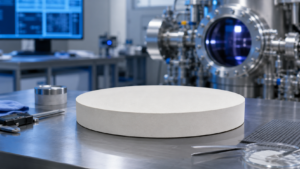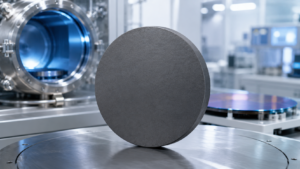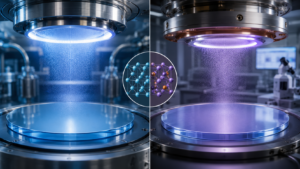
Hafnium oxide, commonly written as HfO₂, is widely investigated and applied as a high-k dielectric, optical coating material, protective ceramic layer, and functional oxide for advanced electronic devices. Its relatively high dielectric constant, wide band gap, thermal stability, and compatibility with silicon-based processes make HfO₂ thin films relevant to semiconductor gate dielectrics, capacitors, optical multilayers, sensors, resistive memory, and ferroelectric devices.
However, obtaining a high-quality HfO₂ film requires more than selecting the correct deposition power and oxygen flow. The purity, density, microstructure, and condition of the sputtering target can influence plasma stability, particle generation, deposition consistency, film stoichiometry, and defect levels.
This article explains how HfO₂ target purity and relative density affect thin-film performance and how engineers should evaluate these parameters when selecting a hafnium oxide sputtering target.
Why Target Quality Matters in HfO₂ Sputtering
During sputtering, energetic ions bombard the target surface and eject atoms or molecular species into the vacuum chamber. These species travel toward the substrate and form a thin film.
The final film is influenced by several interconnected factors:
- Target composition and purity
- Target density and porosity
- Grain structure and phase distribution
- Sputtering power and pressure
- Oxygen and argon flow rates
- Substrate temperature and bias
- Target-to-substrate distance
- Post-deposition annealing
- Chamber cleanliness and base pressure
Research on sputtered HfO₂ films shows that oxygen flow, sputtering conditions, annealing temperature, and deposition geometry can significantly affect film stoichiometry, crystallinity, density, refractive index, roughness, and electrical behavior.
The target should therefore be considered part of the deposition process rather than merely a consumable material.
How Target Purity Affects HfO₂ Thin Films
Target purity indicates how much of the target consists of the specified HfO₂ material and how much consists of unintended metallic, nonmetallic, or process-related impurities.
Common commercial purity levels include:
| Nominal Purity | Typical Use |
|---|---|
| 99.9% | General coating development and noncritical laboratory work |
| 99.95% | Research, optical coatings, and functional film development |
| 99.99% | Semiconductor, dielectric, optical, and advanced electronic applications |
| Higher custom grades | Specialized electronic or low-defect deposition programs |
A higher nominal purity does not automatically guarantee a better film in every process. However, when electrical leakage, optical absorption, interface quality, or reproducibility is critical, impurity control becomes increasingly important.
Metallic Impurities and Electrical Leakage
Unwanted metallic elements may introduce electrically active defect states into an insulating HfO₂ layer. Depending on their identity, concentration, and oxidation state, these impurities can alter:
- Leakage current
- Breakdown strength
- Charge trapping
- Dielectric loss
- Threshold-voltage stability
- Resistive-switching behavior
For high-k dielectric applications, even a small concentration of electrically active impurities may matter because the film is often only a few nanometers or tens of nanometers thick.
The effect is not determined by total purity alone. The individual impurity profile is equally important. Two targets labeled 99.99% may contain different residual elements and may not perform identically in the same process.
For critical applications, buyers should therefore request an actual impurity analysis rather than relying only on the nominal purity designation.
Impurities and Optical Absorption
HfO₂ is also used as a high-index material in optical coatings. In these applications, transition-metal impurities, suboxide formation, oxygen deficiency, and structural defects can increase absorption or change the extinction coefficient.
Research on ion-beam-sputtered HfO₂ has shown that substoichiometry can be a major contributor to higher-than-expected optical absorption. Appropriate annealing can reduce some of these defects, but it does not replace the need for controlled source material and stable deposition conditions.
Studies of magnetron-sputtered HfO₂ optical films also connect point defects and the O/Hf atomic ratio with optical performance and laser-damage behavior.
Impurity Segregation and Particle Formation
Certain impurities may not remain uniformly distributed throughout a ceramic target. During sintering or prolonged sputtering, they may segregate at grain boundaries or form secondary phases.
These regions can sputter differently from the surrounding HfO₂ matrix. Potential results include:
- Localized erosion
- Unstable discharge behavior
- Surface nodules
- Particle release
- Variation in deposition rate
- Changes in film composition over target life
This is one reason why chemical homogeneity is as important as the headline purity number.
How Target Density Affects Sputtering Stability
Ceramic sputtering targets are normally described by bulk density or relative density.
Relative density compares the measured density of the target with the theoretical density of fully dense HfO₂:
[
\text{Relative Density} =
\frac{\text{Measured Bulk Density}}
{\text{Theoretical Density}}
\times 100%
]
A target with lower relative density contains more internal porosity. A higher-density target generally contains fewer interconnected pores, although grain size, pore distribution, cracks, and secondary phases must also be considered.
Porosity and Plasma Instability
Open pores can trap moisture, cleaning solvents, atmospheric gases, or processing residues. Under vacuum and plasma exposure, these trapped species may be released gradually.
Possible consequences include:
- Longer conditioning time
- Fluctuating chamber pressure
- Unstable plasma
- Increased arcing
- Oxygen partial-pressure variation
- Film contamination during initial deposition
For sensitive dielectric and optical films, this can reduce run-to-run consistency.
Density and Particle Generation
A porous target usually has more weakly supported regions around pores and grain boundaries. Repeated ion bombardment and thermal cycling can cause these regions to loosen or fracture.
Released particles may reach the substrate and produce:
- Pinholes
- Surface bumps
- Local film-thickness variation
- Electrical weak points
- Reduced device yield
- Optical scattering centers
Target density is therefore especially important in processes requiring smooth, low-defect films over large areas.
Density and Target Erosion
A dense, homogeneous target normally erodes more uniformly than a target containing uneven pores, local density variation, or poorly bonded grains.
Nonuniform erosion may produce:
- Deep local erosion tracks
- Surface roughening
- Irregular deposition rates
- Changes in film uniformity
- Premature target failure
- Increased risk of cracking near the end of target life
The density value should therefore represent the target as a whole rather than a single favorable measurement point.
Density and Thermal Behavior
HfO₂ is a ceramic material and has substantially different thermal and mechanical behavior from a metallic sputtering target. Pores interrupt heat-transfer paths and create local stress-concentration regions.
During sputtering, the front surface is heated by plasma bombardment while the rear surface is cooled through the backing plate or cathode. If heat is not transferred uniformly, local temperature differences may develop.
These gradients can contribute to:
- Thermal stress
- Microcrack propagation
- Bonding failure
- Target fracture
- Unstable sputtering at higher power
Higher density generally supports more uniform heat transfer, but the complete assembly remains important. Target thickness, backing-plate material, bonding quality, cooling-water conditions, power ramping, and cathode design all affect thermal reliability.
Purity and Density Affect Different Aspects of Film Quality
Purity and density are related to target quality, but they are not interchangeable.
| Target Property | Main Function | Possible Film or Process Impact |
| Chemical purity | Limits unwanted elements | Lower contamination, improved electrical and optical consistency |
| Impurity profile | Identifies specific residual elements | Better control of leakage, absorption, and defect states |
| Relative density | Indicates degree of ceramic consolidation | Improved plasma stability and reduced particle generation |
| Pore distribution | Shows whether porosity is isolated or interconnected | Influences outgassing, cracking, and erosion |
| Grain structure | Describes microstructural uniformity | Affects sputtering consistency and surface evolution |
| Phase composition | Confirms the intended ceramic phase | Reduces composition variation and secondary-phase sputtering |
| Bonding quality | Controls heat transfer to the backing plate | Reduces overheating, debonding, and target cracking |
A high-purity but poorly densified target may still generate particles and unstable discharge behavior. Conversely, a very dense target containing unsuitable impurities may produce smooth films with unacceptable electrical or optical properties.
Both parameters must therefore be evaluated together.
Relationship Between Target Quality and Film Stoichiometry
Even when a stoichiometric HfO₂ ceramic target is used, the deposited film may not have an exact O/Hf ratio of 2.0.
Film stoichiometry can be affected by:
- Preferential sputtering
- Oxygen loss at the target surface
- Oxygen partial pressure
- Chamber background gases
- Plasma energy
- Substrate temperature
- Resputtering of oxygen from the growing film
- Post-deposition annealing
Oxygen-deficient HfO₂₋ₓ may contain oxygen vacancies and hafnium suboxide states. These defects can strongly influence conductivity, charge trapping, refractive index, band structure, and resistive-switching behavior.
Experiments on sputtered HfO₂ films have shown that oxygen flow directly affects composition, crystallinity, film density, refractive index, extinction coefficient, and surface roughness.
Research on oxygen-deficient HfO₂₋ₓ also demonstrates that changes in suboxide concentration and oxygen-vacancy states can move films between more insulating and more conductive behavior.
This means that target purity helps control the source material, but oxygen stoichiometry must still be controlled through the deposition recipe.
Effects on Electrical Properties
For dielectric applications, important thin-film characteristics include:
- Dielectric constant
- Leakage-current density
- Breakdown field
- Interface-trap density
- Fixed-charge density
- Charge-trapping behavior
- Capacitance stability
A smooth, stoichiometric and low-contamination film is generally preferred for conventional insulating applications.
As-deposited sputtered HfO₂ films are often amorphous, while annealing may induce crystallization. Crystallization can increase dielectric response in some systems, but grain boundaries may also create leakage pathways. One RF-sputtering study found smooth, crack-free amorphous films before annealing and increased leakage after high-temperature crystallization.
Another study of ultrathin RF-sputtered HfO₂ reported amorphous as-deposited films and used post-deposition annealing to obtain the desired dielectric and structural properties.
Target quality should therefore be evaluated together with the required film phase and thermal budget.
Effects on Optical Properties
For optical coatings, HfO₂ films may be selected for their:
- High refractive index
- Wide optical band gap
- Low absorption
- Low scattering
- Thermal stability
- Potentially high laser-damage resistance
Target porosity and particle generation can raise surface roughness and scattering. Chemical impurities and oxygen deficiency can increase absorption or alter the optical constants.
Deposition studies show that oxygen-flow control can produce HfO₂ films with different refractive indices, band-gap values, extinction coefficients, and roughness levels.
Post-deposition annealing can reduce absorption and stress under suitable conditions, but excessive annealing may cause crystallization and deterioration of optical performance. A 2024 study of ion-beam-sputtered HfO₂ found improved properties below approximately 500°C, while higher temperatures caused crystallization and degraded optical behavior in that particular process.
Recommended Target Specifications by Application
The correct target specification depends on the sensitivity of the intended film.
| Application | Suggested Target Considerations |
| General university research | Suitable nominal purity, documented composition and stable ceramic density |
| Optical coatings | High purity, low transition-metal contamination, high density and low particle generation |
| Semiconductor dielectrics | High purity, detailed impurity analysis, high density and consistent batch documentation |
| Capacitors and sensors | Controlled composition, low contamination and reproducible sputtering behavior |
| Resistive memory | Defined impurity and oxygen-vacancy strategy, consistent target composition |
| Ferroelectric HfO₂-based films | Accurate dopant or Hf/Zr ratio, strong compositional homogeneity and phase control |
| High-power or long-run sputtering | High density, robust bonding, suitable thickness and controlled power ramping |
These are selection principles rather than universal acceptance limits. The appropriate purity and density should be determined by the device requirements, process window, film thickness, substrate size and available sputtering equipment.
What to Request from an HfO₂ Target Supplier
A target quotation should include more than material name and outside dimensions.
Consider requesting the following information:
- HfO₂ purity and calculation basis
- Individual impurity analysis
- Measured bulk density or relative density
- Manufacturing route
- Grain structure or microstructural information
- Phase verification, where required
- Surface finish and edge condition
- Dimensional tolerances
- Bonding method
- Backing-plate material and dimensions
- Recommended maximum starting power
- Certificate of Analysis and dimensional report
For custom assemblies, provide the cathode model, target drawing, backing-plate drawing, cooling arrangement, intended power range and whether the target will be operated in RF, pulsed DC or another configuration.
Common Selection Mistakes
Selecting by Purity Alone
Purity is important, but it does not describe density, pore distribution, cracking risk, bonding, surface quality or dimensional accuracy.
Selecting by Density Alone
A dense target may still contain undesirable impurities or secondary phases. Density cannot replace chemical analysis.
Assuming the Target Controls Film Stoichiometry by Itself
Even a stoichiometric ceramic target can deposit an oxygen-deficient film when oxygen partial pressure, plasma conditions or substrate conditions are unsuitable.
Ignoring Bonding and Cooling
Ceramic targets can fail even when the material itself is high quality if the bonding layer is incomplete or the cathode cooling is insufficient.
Comparing Suppliers Using Different Test Methods
One supplier may report apparent density, another may report bulk density, and another may provide relative density calculated using a different theoretical reference. Test methods should be compared on the same basis.
Frequently Asked Questions
Is 99.9% HfO₂ sufficient for sputtering?
It may be sufficient for general coating development and preliminary research. Semiconductor, optical and low-defect applications often require higher purity and a detailed impurity profile.
Does higher target density always produce a denser film?
Not automatically. Target density supports stable sputtering and lower particle generation, but film density is also controlled by plasma energy, pressure, substrate temperature, ion assistance and deposition rate.
Can oxygen flow compensate for a low-purity target?
No. Oxygen flow can adjust oxidation state and film stoichiometry, but it cannot remove metallic or process-related impurities introduced by the target.
Why does an HfO₂ target arc during RF sputtering?
Possible causes include surface contamination, trapped gases, open porosity, particles, excessive starting power, poor grounding, chamber contamination or an unsuitable pressure range.
Is a bonded HfO₂ target better than an unbonded target?
For many ceramic targets, bonding to a copper or compatible backing plate improves mechanical support and heat transfer. The correct configuration depends on target size, thickness, cathode design and operating power.
Should target density be specified as a percentage?
Relative density is useful, but the theoretical density and measurement method should also be stated. Buyers should avoid comparing percentage values calculated using different references.
Conclusion
HfO₂ thin-film quality depends on the interaction between target quality and deposition conditions.
Target purity primarily influences contamination, defect chemistry, optical absorption and electrical consistency. Target density primarily affects plasma stability, outgassing, particle generation, erosion uniformity and thermal reliability. Neither parameter should be considered independently.
For demanding semiconductor, optical and electronic applications, an HfO₂ sputtering target should provide:
- Appropriate chemical purity
- A documented impurity profile
- High and uniform ceramic density
- Controlled porosity and grain structure
- Reliable bonding and dimensional accuracy
- Batch-specific quality documentation
At the same time, the sputtering process must control oxygen flow, working pressure, power density, substrate temperature and post-deposition annealing.
Thin Film Materials supplies custom hafnium oxide sputtering targets in disc, rectangular and drawing-specific configurations, with optional backing plates and bonding services. Purity, dimensions, density requirements, surface condition and documentation can be specified according to the deposition system and intended film application.
For detailed specifications, target configuration review and a quotation, please contact sales@thinfilmmaterials.com.