The global push for device miniaturization across medical implants, active RFID tags, wireless sensor networks, and advanced wearables has pushed traditional energy storage technologies to their physical constraints. As silicon chips shrink, the demand for integrated, micro-scale power sources has skyrocketed. This technological shift positions Thin-Film Lithium-Ion Batteries (TFLIBs) and solid-state micro-batteries as critical enabling components for next-generation electronics.
At the absolute center of high-performance TFLIB architecture is the cathode thin film. Lithium Cobalt Oxide (LiCoO2, or LCO) remains the industry benchmark for thin-film cathodes due to its high theoretical volumetric energy density, highly stable discharge voltage plateau, and excellent structural retention during prolonged cycling. However, reproducing high-quality electrochemical LCO films inside a vacuum chamber requires a flawless deposition source.
For process engineers and researchers, choosing a high-density, precise-purity LiCoO2 sputtering target is the single most critical factor in controlling film stoichiometry, reducing defect densities, and maximizing device production yields.
1. Fundamentals of RF Magnetron Sputtering for LiCoO2 Thin Films
Lithium Cobalt Oxide is a complex ceramic oxide. Depositing it via Physical Vapor Deposition (PVD) introduces distinctive thermodynamic and kinematic challenges, primarily centered around structural lithium loss and phase crystallization.
Because LiCoO2 is an electrical insulator at room temperature, Radio Frequency (RF) Magnetron Sputtering must be utilized rather than Direct Current (DC) methods. RF sputtering prevents the destructive accumulation of positive surface charges on the ceramic target, maintaining a stable plasma discharge throughout extended deposition runs.
[RF Power Source] ---> [Plasma Glow Zone (Ar+ Ions)]
                             │
                             ▼
               [High-Density LiCoO2 Target]
                             │
            (Sputtered Li, Co, and O Species)
                             │
                             ▼
         [Substrate Heater (500°C - 700°C) / Substrate]
During the thin-film deposition sequence, energetic argon ions ($Ar^+$) bombard the target surface, ejecting lithium, cobalt, and oxygen atoms. Because lithium atoms are significantly lighter than cobalt atoms, they undergo substantial preferential scattering when colliding with working gas molecules.
To counteract this phenomenon and prevent the formation of lithium-deficient phases, engineers must carefully optimize the process envelope by modifying ambient gas ratios or utilizing specialized target chemistries.
Key Process Parameters for Optimizing LCO Crystallization:
- Reactive Sputtering Atmosphere: Utilizing a balanced Argon/Oxygen ($Ar/O_2$) gas mixture is mandatory to compensate for oxygen loss during fragmentation and maintain precise oxygen stoichiometry in the growing film.
- Working Process Pressure: Typically tightly governed between 0.5 Pa and 1.5 Pa. Lower pressures increase kinetic energy but can cause film resputtering, whereas higher pressures reduce film density due to excessive scattering.
- Thermal Annealing Protocols: As-deposited LCO films processed at room temperature are typically amorphous. To trigger crystallization into the electrochemically active, layered rhombohedral High-Temperature phase (HT-LiCoO2), the film must undergo in-situ substrate heating or a post-deposition ex-situ atmospheric anneal at 500°C to 700°C.
2. Technical Specifications of TFM LiCoO2 Sputtering Targets
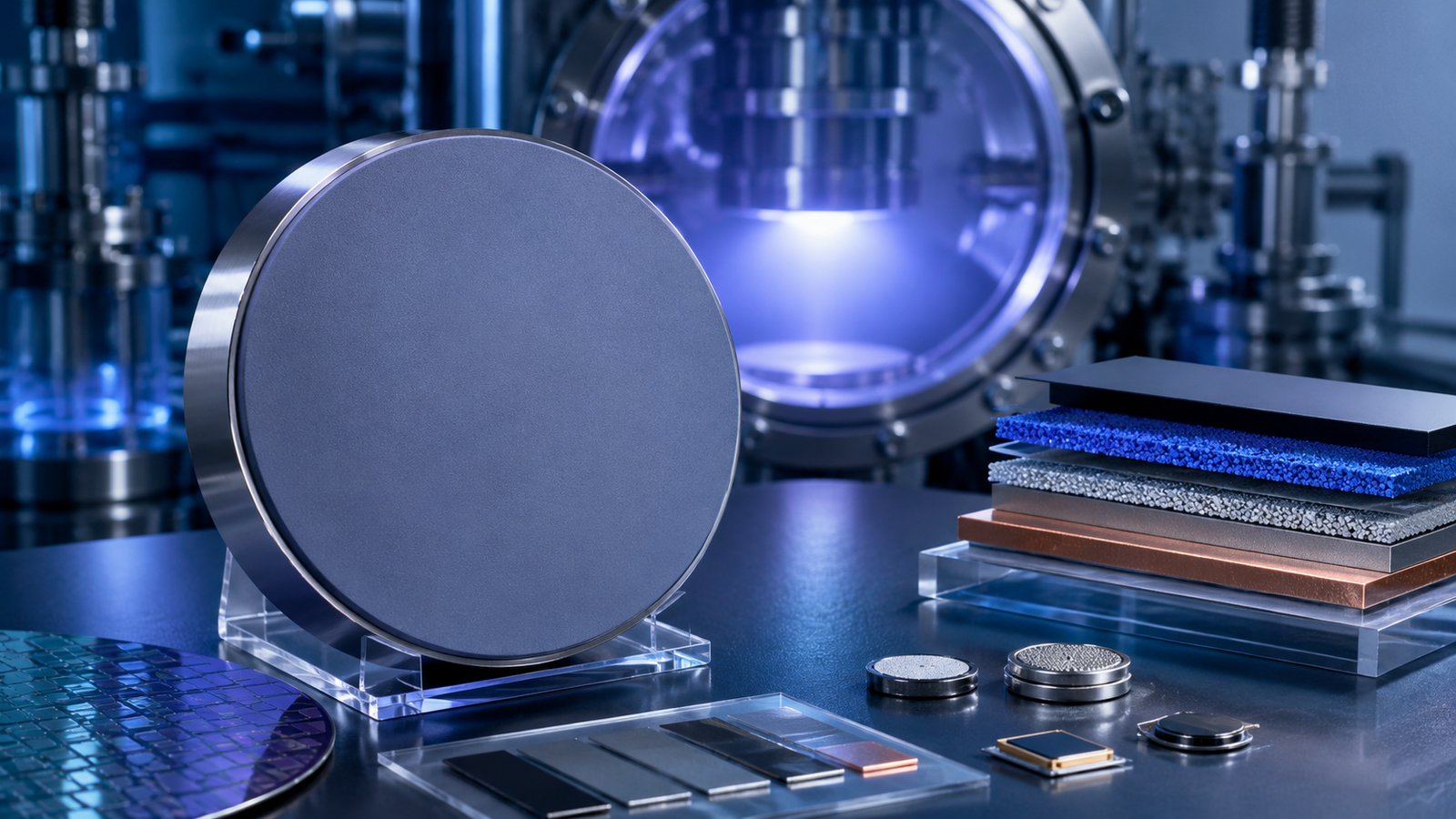
Thin Film Materials (TFM) utilizes advanced hot-isostatic pressing (HIP) and vacuum sintering methodologies to produce high-density ceramic sputtering targets. This ensures that our materials provide stable performance over their entire operational lifespan.
Table 1: Comprehensive Material and Mechanical Specifications
| Physical & Chemical Parameter | Industry Benchmark Requirements | TFM Premium Specifications |
| Chemical Formula | $LiCoO_2$ | $LiCoO_2$ (Custom lithium enrichment available) |
| Purity Grades | 99.9% (3N) | 99.9% (3N) to 99.95% (3N5) |
| Theoretical Density | $5.16 \text{ g/cm}^3$ | $5.16 \text{ g/cm}^3$ |
| Relative Target Density | > 90% | > 95% (Typical values range from 96% to 98%) |
| Crystal Phase Structure | Layered Rhombohedral | Single Phase HT-type (Verified via XRD) |
| Geometric Configurations | Planar Circular / Rectangular | Circular (up to 18″), Rectangular Multi-tile, Stepped |
| Backing Plate Integration | Standard Bonding | Oxygen-Free Copper (OFC) or Molybdenum (Mo) |
3. Comparative Evaluation: LiCoO2 vs. Alternative Thin-Film Cathodes
Selecting the ideal cathode chemistry requires balancing several competing electrochemical factors. While alternative materials such as Lithium Manganese Oxide ($LiMn_2O_4$) and Lithium Iron Phosphate ($LiFePO_4$) are often evaluated, LiCoO2 continues to be the preferred choice for commercial, high-capacity solid-state micro-batteries.
Table 2: Electrochemical and Kinetic Comparison of PVD-Deposited Cathode Materials
| Cathode Thin Film Material | Average Operating Voltage (V) | Volumetric Capacity (mAh/cm3⋅μm) | Electronic Conductivity (S/cm) | PVD Process Complexity & Challenges |
| Lithium Cobalt Oxide ($LiCoO_2$) | 3.9 – 4.2 | ~120 – 140 | $10^{-3}$ to $10^{-4}$ | Moderate: Demands tight regulation of $Ar/O_2$ ratio and thermal annealing. |
| Lithium Manganese Oxide ($LiMn_2O_4$) | 3.8 – 4.0 | ~100 | $10^{-5}$ | High: Highly susceptible to structural manganese dissolution and phase transitions. |
| Lithium Iron Phosphate ($LiFePO_4$) | 3.4 | ~110 | $10^{-9}$ | High: Extremely low native conductivity requires intensive doping or carbon co-deposition. |
The higher inherent electronic conductivity of LiCoO2 minimizes internal resistance within the micro-battery architecture. This eliminates the need for thick, inactive conductive additives that reduce the active volume of the device, making LCO exceptionally well-suited for high-power-density applications.
4. Critical Impacts of Target Density and Purity on Micro-Battery Yields
In commercial thin-film battery manufacturing, target quality dictates production line yields and device reliability. Utilizing sub-par or low-density ceramic oxide targets introduces fatal defects into the active functional layers.
The Mechanics of Micro-Arcing and Nodule Formation
Low-density ceramic targets contain microscopic internal voids and structural inconsistencies. Under the thermal gradients generated by RF magnetron sputtering, these voids undergo severe localized thermal stress, triggering micro-cracking and uneven surface erosion.
As erosion progresses, non-conductive “nodules” develop on the target surface. These nodules induce intense micro-arcing events, which eject macroscopic ceramic fragments into the plasma stream. When these macro-particles land on the substrate, they form pinholes and localized shunts, causing complete electrical short-circuits across the sub-micron solid-state electrolyte layer.
The TFM Quality Safeguard
TFM mitigates these systemic failure modes by controlling grain size distribution and maximizing relative density to levels exceeding 95%. Our advanced manufacturing processes guarantee absolute structural homogeneity. Beyond sputtering, our high-purity evaporation materials are built to the same strict standards to provide defect-free thin films across all vacuum coating configurations.
Table 3: Correlation Matrix: Target Integrity vs. Deposited Film Defect Density
| Process Performance Metrics | Low-Density Target Competitors (< 90%) | TFM Ultra-High Density Targets (> 95%) |
| Micro-Arcing Frequency | High; frequent plasma interruptions and voltage drops | Minimal to zero; highly uniform plasma discharge |
| Deposition Rate Drift | Unpredictable; requires continuous power adjustments | Linear and predictable throughout target lifetime |
| Film Stoichiometry Shift | Cross-wafer variations in the $Li/Co$ atomic ratio | Uniform stoichiometric distribution across wide areas |
| Particulate Incorporation | High defect density; increased micro-battery shorting | Ultra-clean film surfaces; maximized device yield |
| Target Thermal Lifespan | Premature failure caused by structural fracturing | Maximized campaign longevity and operational hours |
5. Industrial Applications of Premium LiCoO2 Thin Films
Films derived from high-purity LiCoO2 targets serve as core functional components in a variety of advanced, high-reliability micro-electronics:
- Solid-State Micro-Batteries (SSBs): Providing non-volatile backup power for on-board real-time clocks (RTCs), micro-controllers, and smart secure credit cards.
- Implantable Medical Electronics: Powering critical deep-brain stimulators, miniaturized pacemakers, and cochlear implants where battery failure is not an option and long cycle life is mandatory.
- Industrial Internet of Things (IoT): Functioning as the energy storage buffer for autonomous wireless sensor networks that utilize ambient thermal, vibrational, or solar energy harvesting.
- Electrochromic Smart Glass: Utilizing the reversible intercalation kinetics of lithium ions to alter optical transparency in aerospace windows and architectural glazing.
6. Why Thin Film Materials (TFM) is Your Trusted B2B Partner
Thin Film Materials (TFM) is a specialized global supplier of high-purity materials for advanced vacuum systems. We focus on engineering solutions that eliminate process variability for researchers and manufacturing engineers alike.
- Engineered Lithium Enrichment: To balance out the light-element volatilization that occurs in specialized RF plasma geometries, TFM manufactures custom-formulated, lithium-enriched targets (e.g., $Li_{1.1}CoO_2$) to help you achieve precise 1:1 stoichiometry in your final films.
- Advanced Indium Metallic Bonding: Ceramic targets are inherently brittle and exhibit low thermal conductivity. TFM offers premium metallic Indium (In) bonding services onto high-conductivity Molybdenum (Mo) or Copper (Cu) backing plates. This guarantees effective heat dissipation, preventing target cracking even at elevated RF power densities.
- Rigorous Analytical Validation: Every material shipped from our facility is accompanied by an exhaustive Certificate of Analysis (COA). This document contains Inductively Coupled Plasma Mass Spectrometry (ICP-MS) data to verify chemical purity and X-ray Diffraction (XRD) patterns to confirm complete phase homogeneity.
7. Frequently Asked Questions (FAQ)
Q1: Why must LiCoO2 be processed via RF sputtering instead of DC sputtering?
LiCoO2 is a multi-component ceramic oxide with very low native room-temperature electrical conductivity. Under a DC bias, positive ions from the plasma accumulate rapidly on the target surface, forming an insulating charge layer that quickly extinguishes the plasma. RF sputtering addresses this by alternating the electric potential, neutralizing charge buildup during each cycle to maintain a stable plasma.
Q2: What is the recommended power density to prevent cracking an LCO target?
Because LiCoO2 is highly susceptible to thermal shock, we recommend keeping the RF power density below 2.0 to 3.0 $W/cm^2$. Furthermore, always implement a gradual power ramp-up and ramp-down routine (ideally $\le$ 10°C/min) to prevent thermal stress fractures.
Q3: How do I adjust the Argon-to-Oxygen ratio to maintain proper film stoichiometry?
The optimal $Ar/O_2$ ratio depends heavily on your chamber geometry and pumping speed, but a typical starting baseline consists of 90% $Ar$ and 10% $O_2$ by flow rate. If your processed films consistently show oxygen deficiencies, gradually increase the oxygen partial pressure while monitoring the deposition rate.
Q4: Does TFM offer custom target dimensions for non-standard PVD systems?
Yes. TFM specializes in custom manufacturing. We can fabricate planar circular, rectangular, or complex stepped configurations tailored precisely to your specific gun architecture and cathode layout.
Q5: What backing plate material is best suited for high-temperature LCO deposition?
Oxygen-Free Copper (OFC) backing plates are standard for high thermal dissipation. However, for applications involving ultra-high vacuum (UHV) systems or high-temperature environments near the cathode, Molybdenum backing plates are available to match thermal expansion coefficients more closely.
Q6: What is the thermal limitation of Indium-bonded LiCoO2 targets?
Indium metal has a relatively low melting point of approximately 156.6°C. Therefore, it is critical to keep the temperature of the bonded interface well below this threshold by ensuring high cooling water flow rates and monitoring return water temperatures.
Q7: How does an increase in target density improve the lifetime of the target?
High-density targets ($>$95%) erode evenly across the racetrack region without developing localized pits or hot spots. This uniform wear pattern delays target burn-through and extends its useful operational life.
Q8: Can I use as-deposited LiCoO2 films directly without thermal annealing?
As-deposited films sputtered at room temperature are typically amorphous and exhibit poor lithium-ion intercalation kinetics. To achieve high volumetric capacity, the films must be annealed at 500°C to 700°C to form the layered rhombohedral HT-phase structure.
Q9: How are TFM targets packaged to prevent environmental degradation?
All TFM ceramic targets are vacuum-sealed inside multi-layer, inert-gas-purged moisture barrier bags. This protects the target surface from atmospheric moisture and carbon dioxide, which can cause the formation of a surface Lithium Carbonate ($Li_2CO_3$) layer prior to installation.
Q10: What is the expected delivery lead time for a custom-engineered LiCoO2 target?
Standard dimensions (such as 2-inch, 3-inch, or 4-inch circular targets) are typically processed and shipped within 2 to 3 weeks. Fully customized geometries or large multi-tile backing assemblies generally require 4 to 6 weeks for precision synthesis, bonding, and quality assurance verification.