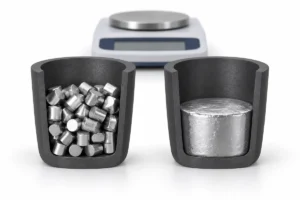
A crucible’s stated capacity does not tell you how many grams of evaporation material to order or load. Loose pellets contain gaps; a consolidated charge occupies less space for the same mass at the same material density. You need to know which condition the volume describes before converting it to a weight.
The calculations below help prepare a material request. They do not establish a safe loading level or approve a material-liner combination. Use the equipment’s operating procedure for those decisions.
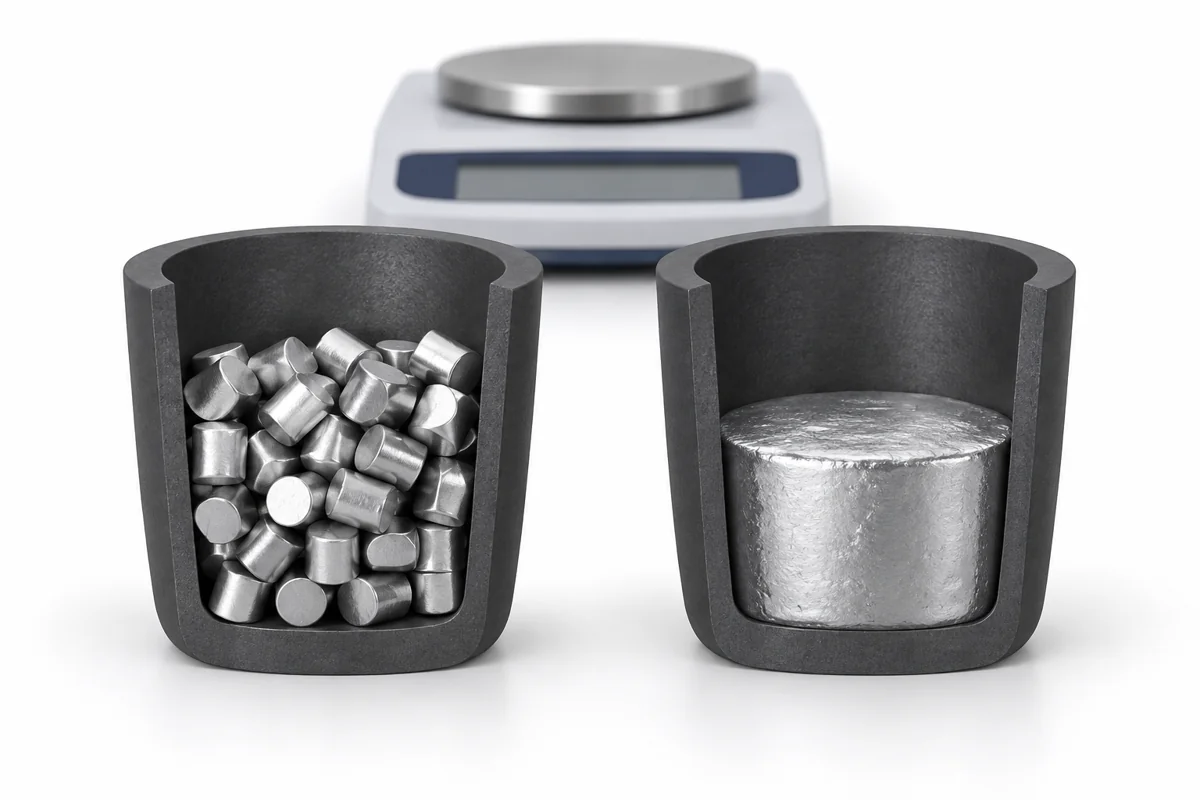
Why the same mass can occupy different volumes
Material density relates mass to the volume occupied by the material itself. A loose bed of pellets also contains spaces between the pellets. Its apparent volume therefore exceeds the solid material volume, even when the pellets are fully dense.
A 100 g package is not an instruction to put 100 g into one crucible. On the purchase request, list the total order mass separately from the intended mass per charge. Then state whether the charge volume refers to loose pieces or consolidated material.
Use the density that matches the calculation
| Quantity | What it describes | How to use it |
|---|---|---|
| Material density | Mass per volume of the material, with composition, phase and temperature specified | Estimate solid or liquid volume using a density appropriate to that state |
| Loose-charge apparent density | Charge mass divided by its occupied envelope volume, including spaces between pieces | Estimate the room-temperature space required by a defined loading method |
| Nominal crucible capacity | The volume stated for a particular crucible or pocket | Check the drawing and definition; it is not automatically the permitted working volume |
The term “bulk density” is ambiguous across documents. In a material handbook it can refer to a bulk solid; in a powder specification it commonly includes spaces between particles. Ask how the value was measured before using it. Do not substitute a powder’s tapped density for a loosely loaded pellet charge.
A worked estimate with explicit assumptions
For a preliminary room-temperature estimate:
Solid material volume = mass ÷ material density
Loose-charge volume = solid material volume ÷ packing fraction
Here, packing fraction means the fraction of the charge envelope occupied by solid material. The example below assumes fully dense pieces. It does not account for porosity within a pellet.
Assume a hypothetical charge has a mass of 24 g and a solid material density of 8 g/cm³. Its solid volume is 3 cm³. If an assumed packing fraction is 0.60, its loose-charge envelope is 5 cm³. At a packing fraction of 0.50, that envelope becomes 6 cm³.
The numbers are hypothetical. They are not TFM material data or recommended packing factors. Changing the assumed packing fraction has changed the required space by 1 cm³ without changing the mass. For an actual charge, record how the loading volume was measured; label an unmeasured packing estimate as an assumption.
A copper example using a published density
The Royal Society of Chemistry’s copper reference lists a density of 8.96 g/cm³ and defines its density values at room temperature. Use that reference value for the following estimate of 30.0 g of solid copper:
| Calculation | Result | Basis |
|---|---|---|
| Solid volume: 30.0 ÷ 8.96 | 3.35 cm³ | Published room-temperature density; assumed fully dense copper |
| Loose volume: (30.0 ÷ 8.96) ÷ 0.60 | 5.58 cm³ | Assumed 60% packing fraction, not measured |
| Loose volume: (30.0 ÷ 8.96) ÷ 0.50 | 6.70 cm³ | Assumed 50% packing fraction, not measured |
The 30.0 g quantity is a chosen example, not a recommended charge. Only the material density is sourced; neither packing fraction is a TFM test result. The 3.35 cm³ value describes solid copper at room temperature, not its molten volume. Actual loading still requires the pellet dimensions, charge condition and equipment-approved limits. This calculation does not establish that a nominal 6 cm³ crucible can safely accept the charge.
Bar lengths compare calculated volumes on one scale. They do not show crucible fill height or a safe loading limit. Values are rounded after calculation.
A worksheet for your charge estimate
Keep units consistent: 1 cm³ = 1 mL, and 1 cm³ = 1,000 mm³. Enter density in g/cm³ and mass in grams. Write 60% packing as 0.60 in the equation.
| Input | Record | Check |
|---|---|---|
| Mass, m (g) | Proposed mass per charge | Keep total order mass separate |
| Material density, ρ (g/cm³) | Value, source, composition, phase and temperature | Do not use liquid density for a room-temperature solid estimate |
| Packing fraction, φ | Measured value or explicitly labeled assumption | Use a fraction greater than zero and no greater than one; confirm the fully dense pieces assumption |
| Allowed loose-charge envelope, V (cm³) | Limit and its equipment-procedure reference, if defined | A nominal crucible capacity or molten fill limit does not establish this value |
Estimate space from mass: Vloose = m ÷ (ρ × φ)
Estimate mass for a defined loose envelope: m = Vloose × ρ × φ
The reverse equation is usable only when the loose-charge envelope has been established independently. If it is unknown, report the estimated space requirement and leave the loading decision open. Do not substitute nominal capacity and call the result an approved charge mass.
For the copper example, reducing the assumed packing fraction from 0.60 to 0.50 increases estimated space by 20%. The range 5.58 to 6.70 cm³ reflects those two assumptions; it is not a confidence interval or a tested operating range.
Copyable estimate record for an RFQ
Material / composition: [specify]
Form and dimensions: [specify]
Proposed mass per charge (g): [value]
Density (g/cm³), source, phase and temperature: [specify]
Packing fraction and basis: [measured / assumed / unknown]
Estimated loose-charge volume (cm³): [result or unresolved]
Crucible drawing and capacity definition: [reference]
Applicable loading procedure and unresolved checks: [reference / questions]
Total order mass and package subdivision: [specify]
Check what “fill level” means
A percentage of height and a percentage of volume are different in a tapered crucible. Confirm whether a supplier’s fill instruction describes loose material, a consolidated charge or a molten pool, and whether the stated capacity belongs to the bare hearth or the installed liner.
Kurt J. Lesker’s e-beam crucible fill calculator explicitly treats its fill estimate as a fully melted condition and excludes packing density. Its instructions also distinguish initial loading from the final melt level. Those qualifications matter more than copying a percentage into a purchase specification. Follow the applicable equipment and material-specific procedure; no universal fill percentage is proposed here.
A solid-state estimate does not predict the exact hot melt height. Density can change with temperature and phase, and material may be lost during conditioning. Materials that sublime or decompose require a different assessment from a simple melting-and-consolidation model.
Turn the calculation into a usable RFQ
If the material form is still undecided, use the existing pellets, rods and pieces selection guide first. For a charge already specified, send the following information together:
- Material or composition, required purity basis, and any restricted impurities.
- Form and dimensions or size range, including any limits on fines.
- Total purchase mass, proposed mass per charge, and requested package subdivision.
- Equipment model, pocket or crucible drawing, liner material and internal geometry.
- Charge condition: loose as supplied, consolidated, or replenishment for an existing charge.
- Density source, temperature and state, plus any measured or assumed packing factor.
- The operating procedure’s loading constraint and any unresolved compatibility questions.
“Packing factor not yet measured” is a useful entry on an RFQ. It tells the reviewer what still needs checking. For an alloy such as aluminum-copper evaporation material, identify the requested composition; the density of either pure element is not a substitute. Availability and final specifications require quotation-specific confirmation.
Charge mass does not predict deposited film thickness
Do not use all the purchased or loaded material as the mass deposited on the substrates. Some material remains in the source or deposits elsewhere in the chamber. A charge calculation addresses loading; it does not establish deposition efficiency.
For thickness monitoring, INFICON’s TM-series manual, section 7 treats film density and tooling factor as separate inputs, with tooling accounting for deposition geometry between sensor and substrate. A loose pellet packing factor is not the film-density setting for a thickness monitor.
Frequently asked questions
How do I convert crucible capacity from cm³ to grams?
For a volume occupied entirely by material, multiply volume by the density for that material and state. For a loose charge of fully dense pieces, mass = occupied charge volume × material density × packing fraction. First establish the permitted charge envelope from the equipment procedure. The crucible’s nominal capacity alone does not provide that limit.
How does pellet loading volume differ from molten volume?
A loose pellet charge includes gaps between pieces. A consolidated melt no longer has those same inter-pellet gaps, but its density is also different from the room-temperature solid value. Estimating melt volume therefore needs the retained mass and an appropriate liquid density at the relevant temperature. A solid-volume calculation cannot supply the exact melt height.
Does 60% packing mean the crucible should be filled to 60%?
No. Packing fraction describes how much of the loose charge envelope is solid material. Crucible fill fraction describes how much of the container’s defined capacity is occupied. They have different denominators. The 60% packing value in the copper example is an assumption, not a loading instruction.
Can charge mass predict deposited film thickness?
Not by itself. You also need to know how much material reaches the substrate, its coated area and the film density. Source residue and deposition elsewhere in the chamber prevent the loaded mass from being treated as deposited film mass. Use the qualified thickness-monitoring method for the process.
Can I use pure copper density for an Al-Cu alloy charge?
No. Use a density appropriate to the specified alloy composition, phase and temperature. If that value is unavailable, record the gap in the RFQ rather than presenting a pure-element calculation as an alloy result.
Related products
Copper evaporation material (Cu)
The elemental material used in the worked estimate. Confirm the required form, dimensions, purity basis and quantity in the quotation.
Aluminum-copper evaporation material (Al/Cu)
For an alloy request, specify composition and confirm its density basis separately. Pure copper density does not describe the alloy charge.
Prepare the material and crucible requirements together
Use the evaporation materials catalog to identify the material and the crucible range to identify the container geometry. Neither a matching nominal volume nor a matching material name proves compatibility.
Send TFM your charge specification and crucible drawing, with the estimate and unresolved assumptions attached. Keep the approved loading procedure separate from the purchasing quantity so the quotation and the operating instructions cannot be confused.