
 MSDS File
Introduction
Aluminum Scandium Evaporation Materials (Al/Sc) are advanced alloy sources developed for high-performance thin film deposition where mechanical strength, grain refinement, and enhanced electrical or piezoelectric functionality are required. The addition of scandium to aluminum significantly modifies microstructure and phase stability, making Al/Sc alloys especially valuable in microelectronics, MEMS, and advanced functional coatings.
In vacuum evaporation systems, alloy homogeneity and controlled composition are critical to achieving consistent film properties. Pre-alloyed Al/Sc evaporation materials provide reliable vapor composition and stable deposition behavior for both research-scale experiments and industrial production processes.
Detailed Description
Aluminum (Al) is widely used in thin film applications due to its low density, high electrical conductivity, and good reflectivity. When alloyed with scandium (Sc), even at low concentrations, scandium promotes the formation of fine Al₃Sc precipitates, which significantly enhance mechanical strength, thermal stability, and grain refinement.
Key characteristics include:
Pre-Alloyed Composition – Uniform Al/Sc ratio ensures predictable thin film chemistry.
Customizable Sc Content – Typical scandium additions range from 0.1 wt% to several percent, depending on application needs.
High Metal Purity (3N–5N base aluminum) – Minimizes contamination in electronic and functional films.
Dense, Homogeneous Structure – Supports smooth evaporation and stable deposition rates.
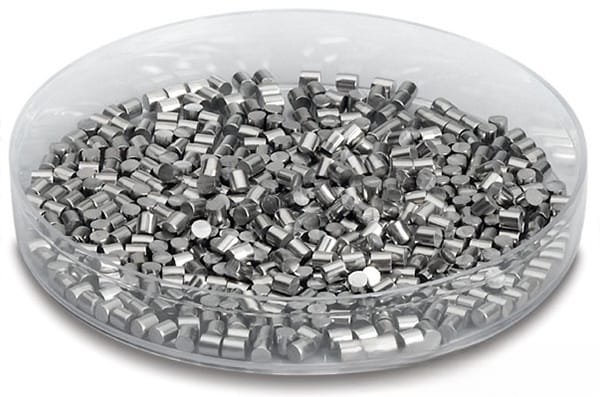
Al/Sc evaporation materials are supplied as lumps, granules, or pellets compatible with tungsten boats, molybdenum crucibles, or graphite liners. Because scandium has a higher melting point than aluminum, process optimization—particularly controlled heating rates—is important to maintain alloy composition during evaporation.
The resulting thin films can exhibit improved thermal stability, enhanced mechanical properties, and refined microstructure compared to pure aluminum films.
Applications
Aluminum Scandium Evaporation Materials are widely used in:
Microelectronics & Interconnects
Aluminum-based conductive films with enhanced reliability and reduced electromigration.MEMS Devices
Structural layers requiring improved strength and thermal stability.Piezoelectric & Functional Thin Films
Precursor layers for AlScN-based piezoelectric materials in RF filters and sensors.Aerospace & Advanced Coatings Research
Lightweight, high-strength alloy thin films for specialized applications.Thin Film Materials Development
Investigation of grain refinement and precipitation strengthening in deposited alloys.
Technical Parameters
| Parameter | Typical Value / Range | Importance |
|---|---|---|
| Purity | 99.9% – 99.999% (base Al purity) | Reduces electronic defects |
| Composition | Custom Al/Sc ratio (wt% or at%) | Controls strength & functional properties |
| Form | Pieces / Granules / Pellets | Compatible with evaporation sources |
| Melting Behavior | Composition-dependent (~660°C base Al) | Influences evaporation profile |
| Density | ≥ 99% theoretical | Ensures stable vaporization |
| Packaging | Vacuum-sealed / inert-packed | Prevents oxidation |
Comparison with Related Materials
| Material | Key Advantage | Typical Application |
|---|---|---|
| Aluminum Scandium (Al/Sc) | Grain refinement & enhanced thermal stability | MEMS & advanced electronics |
| Pure Aluminum (Al) | High conductivity & low density | Interconnect layers |
| Aluminum Copper (Al/Cu) | Improved strength & electromigration resistance | IC metallization |
| Aluminum Silicon (Al/Si) | Good casting and stability characteristics | General coatings |
Compared with pure aluminum, Al/Sc alloys provide significantly improved mechanical performance and thermal resistance, making them suitable for demanding thin film applications.
FAQ
| Question | Answer |
|---|---|
| Can the scandium content be customized? | Yes, the Sc percentage can be tailored to meet specific electrical or mechanical performance targets. |
| Is the material supplied pre-alloyed? | Yes, standard Al/Sc evaporation materials are pre-alloyed to ensure compositional uniformity. |
| What deposition methods are suitable? | Compatible with thermal and electron beam evaporation systems. |
| Are custom sizes available? | Yes, material form and particle size can be customized based on equipment requirements. |
| Which industries use Al/Sc films most? | Semiconductor manufacturing, MEMS fabrication, RF device development, and advanced materials research. |
Packaging
Our Aluminum Scandium Evaporation Materials are meticulously tagged and labeled externally to ensure efficient identification and maintain high standards of quality control. We take great care to prevent any potential damage during storage and transportation, ensuring the materials arrive in perfect condition.
Conclusion
Aluminum Scandium Evaporation Materials (Al/Sc) offer a high-purity, compositionally flexible solution for depositing strengthened and thermally stable aluminum-based thin films. With customizable alloy ratios, consistent microstructure, and reliable packaging, Al/Sc materials support advanced microelectronic, MEMS, and functional thin film applications.
For detailed specifications and a quotation, please contact us at sales@thinfilmmaterials.com.
Reviews
There are no reviews yet.