
Introduction
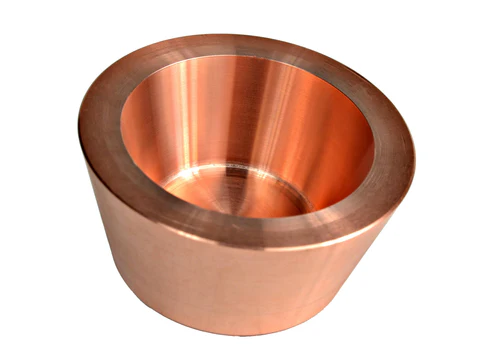
Copper Crucibles are essential components in laboratory research, metallurgical processing, and vacuum or inert-atmosphere thermal applications. Thanks to copper’s outstanding thermal conductivity and excellent heat dissipation capability, copper crucibles are widely used where precise temperature control, rapid heat transfer, and stable thermal environments are required. They are especially valued in induction heating, vacuum melting, and materials research involving reactive or high-value metals.
Detailed Description
Copper Crucibles are typically manufactured from high-purity copper, including Oxygen-Free High Conductivity (OFHC) copper or refined electrolytic copper grades, to ensure minimal contamination during high-temperature processing. The low impurity content reduces the risk of unwanted reactions and improves reproducibility in experimental and industrial workflows.
The key advantage of copper as a crucible material lies in its exceptionally high thermal conductivity, which enables fast and uniform heat distribution. This property is critical in applications such as induction melting, arc melting, and directional solidification, where thermal gradients must be carefully controlled. In addition, copper crucibles exhibit excellent resistance to thermal shock, allowing repeated heating and cooling cycles without cracking or deformation.
Copper crucibles can be machined into various geometries, including cylindrical, conical, rectangular, or custom-designed cavities, depending on furnace configuration and process requirements. Surface finishes can be optimized to reduce adhesion of molten materials, and optional water-cooling channels can be integrated for high-power or continuous-operation systems.
Applications
Copper Crucibles are used across a wide range of scientific and industrial fields, including:
Vacuum and inert-gas melting of metals and alloys
Induction heating and induction melting systems
Arc melting and levitation melting equipment
Semiconductor and electronic materials research
Metallurgical R&D and alloy development
Crystal growth and solidification experiments
High-temperature material testing and prototyping
Technical Parameters
| Parameter | Typical Value / Range | Importance |
|---|---|---|
| Material Grade | High-purity Cu / OFHC Cu | Minimizes contamination during melting |
| Purity | ≥ 99.9% (up to 99.99%) | Ensures chemical stability and reproducibility |
| Density | ~8.96 g/cm³ | Indicates material compactness and quality |
| Thermal Conductivity | ~390–400 W/m·K | Enables rapid and uniform heat transfer |
| Operating Environment | Vacuum / Inert gas / Air (limited) | Determines compatible processing conditions |
| Dimensions | Customizable | Fits specific furnaces and experimental setups |
Comparison with Related Materials
| Material | Key Advantage | Typical Application |
|---|---|---|
| Copper Crucible | Exceptional thermal conductivity | Induction & vacuum melting |
| Graphite Crucible | High temperature resistance | Non-reactive metal melting |
| Alumina Crucible | Chemical inertness | Oxide and ceramic processing |
| Tungsten Crucible | Ultra-high melting point | Extreme-temperature environments |
FAQ
| Question | Answer |
|---|---|
| Can copper crucibles be customized? | Yes, dimensions, shapes, and cooling features can be fully customized. |
| Are copper crucibles suitable for vacuum use? | Yes, they are commonly used in vacuum and inert-gas systems. |
| What metals are typically processed in copper crucibles? | Copper crucibles are used for many metals and alloys, especially in induction or arc melting setups. |
| How are copper crucibles packaged? | Vacuum-sealed or moisture-protected packaging with shock-absorbing materials for safe transport. |
Packaging
Our Copper Crucibles are carefully tagged and labeled on the outer packaging to ensure clear identification and strict quality control. Each crucible is securely protected with reinforced cushioning and moisture-resistant materials to prevent deformation or surface damage during storage and transportation, ensuring delivery in optimal condition.
Conclusion
Copper Crucibles offer a reliable combination of high thermal conductivity, excellent thermal stability, and flexible customization, making them a preferred choice for advanced thermal processing and materials research. Their proven performance in vacuum and induction environments ensures consistent results and long service life.
For detailed specifications, customization options, and a quotation, please contact us at sales@thinfilmmaterials.com.
Reviews
There are no reviews yet.