
Introduction
Scandium Indium Iron Oxide (ScInFeO₃) sputtering targets are advanced functional ceramic materials widely used in the deposition of complex oxide thin films. As research in multifunctional oxides continues to expand—particularly in electronics, spintronics, and energy-related devices—materials like ScInFeO₃ have gained increasing attention for their unique structural and electronic properties. This target enables precise control over film composition, making it a valuable choice for both academic research and industrial thin film applications.
Detailed Description
ScInFeO₃ is a complex oxide composed of scandium, indium, and iron, typically exhibiting a perovskite or related crystal structure depending on synthesis conditions. This material is especially interesting due to its potential multiferroic behavior, where magnetic and electric properties can coexist and interact within a single phase.
The sputtering target is manufactured through high-purity powder processing, followed by pressing and sintering under carefully controlled conditions. This ensures a dense, homogeneous structure with minimal porosity, which is critical for achieving stable sputtering performance and uniform thin film deposition.
Key features include:
- Controlled stoichiometry: Maintaining precise Sc:In:Fe ratios ensures consistent film composition and reproducible functional properties.
- High density and low defect content: Improves sputtering efficiency and reduces particle generation during deposition.
- Compatibility with various sputtering techniques: Suitable for RF magnetron sputtering, which is commonly used for oxide materials.
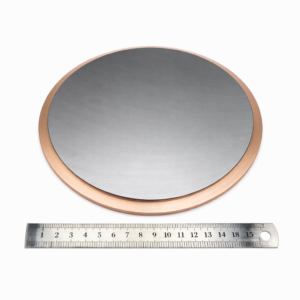
- Optional bonding configurations: Targets can be supplied unbonded or bonded to copper backing plates to enhance thermal conductivity and mechanical stability during high-power sputtering processes.
These characteristics directly impact film quality, including crystallinity, electrical behavior, and interface properties—critical factors in advanced device fabrication.
Applications
ScInFeO₃ sputtering targets are primarily used in research and emerging technologies involving complex oxide thin films. Key application areas include:
- Multiferroic and magnetoelectric devices
- Spintronic materials and magnetic thin films
- Advanced semiconductor research and oxide electronics
- Functional coatings for sensors and memory devices
- Thin film studies in academic and R&D laboratories
Technical Parameters
| Parameter | Typical Value / Range | Importance |
|---|---|---|
| Purity | 99.9% – 99.99% | Ensures stable film composition and minimizes impurities |
| Diameter | 25 – 150 mm (custom available) | Fits various sputtering systems |
| Thickness | 3 – 6 mm | Affects sputtering rate and lifetime |
| Density | ≥ 95% theoretical density | Improves deposition stability and reduces arcing |
| Bonding | Indium / Elastomer / Unbonded | Enhances heat dissipation and mechanical strength |
Comparison with Related Materials
| Material | Key Advantage | Typical Application |
|---|---|---|
| ScInFeO₃ | Multiferroic potential, complex oxide control | Spintronics, oxide electronics |
| ScGaFeO₃ | Different lattice tuning, magnetic behavior | Magnetic thin films |
| BiFeO₃ | Strong ferroelectric properties | Memory devices |
| SrTiO₃ | Excellent dielectric properties | Substrates and capacitors |
FAQ
| Question | Answer |
|---|---|
| Can the composition be customized? | Yes, stoichiometry and element ratios can be tailored based on your application requirements. |
| Is this target suitable for RF sputtering? | Yes, RF magnetron sputtering is recommended for oxide materials like ScInFeO₃. |
| Do you offer bonded targets? | Yes, copper backing plates with indium or elastomer bonding are available. |
| What is the typical lead time? | Standard sizes may be available in stock; custom products typically require 2–4 weeks. |
| Can this material be used for research-scale deposition? | Absolutely, it is widely used in academic and R&D environments. |
Packaging
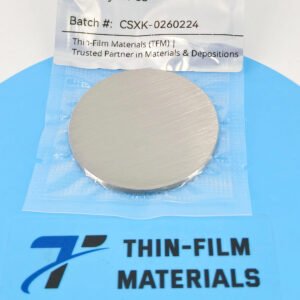
Our Scandium Indium Iron Oxide Sputtering Target (ScInFeO₃) is meticulously tagged and labeled externally to ensure efficient identification and maintain high standards of quality control. We take great care to prevent any potential damage during storage and transportation, ensuring the targets arrive in perfect condition.
Conclusion
ScInFeO₃ sputtering targets offer a reliable and high-performance solution for the deposition of complex oxide thin films with advanced functional properties. With precise composition control, excellent structural quality, and flexible customization options, this material is well-suited for cutting-edge research and specialized industrial applications.
For detailed specifications and a quotation, please contact us at sales@thinfilmmaterials.com.
Reviews
There are no reviews yet.