
 MSDS File
Introduction
Titanium Aluminum (Ti/Al) evaporation materials are engineered alloy sources used in physical vapor deposition (PVD) processes for forming durable, lightweight, and high-performance thin films. By combining titanium’s strength and chemical reactivity with aluminum’s low density and oxidation resistance, Ti/Al materials enable coatings with excellent adhesion, corrosion resistance, and mechanical stability.
Ti/Al evaporation materials are widely applied in semiconductor metallization, decorative coatings, optical layers, and advanced surface engineering systems.
Detailed Description
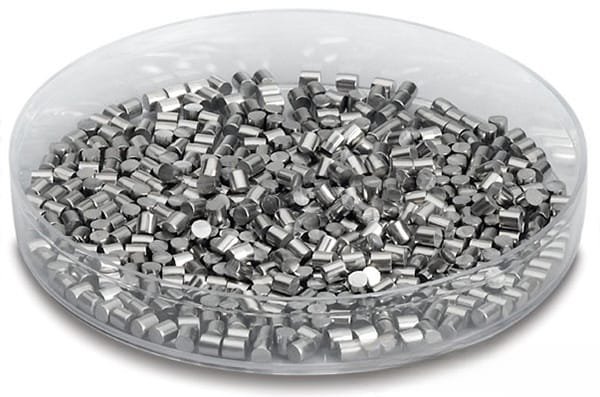
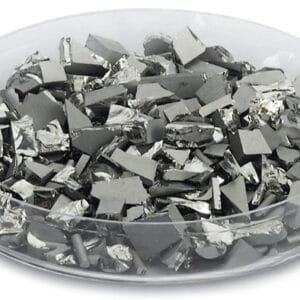
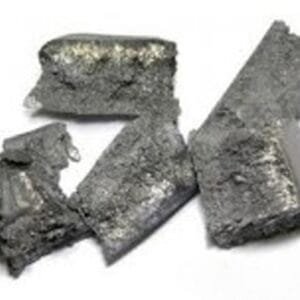
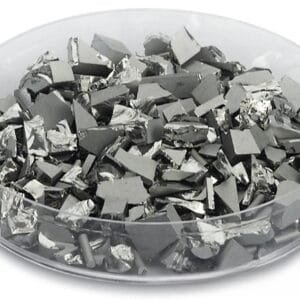
Titanium Aluminum evaporation materials are typically supplied as pre-alloyed pellets, granules, slugs, or custom-shaped pieces designed for thermal or electron beam evaporation. Alloy compositions can be tailored depending on application requirements, with common Ti:Al ratios such as 50:50, 60:40, or application-specific formulations.
Production methods may include vacuum induction melting or powder metallurgy to ensure:
Homogeneous elemental distribution
Controlled alloy composition
Low impurity content
Stable melting behavior during evaporation
The presence of titanium improves film adhesion and enhances mechanical strength, while aluminum contributes to oxidation resistance and reduced density. In high-vacuum evaporation environments, Ti/Al materials exhibit stable evaporation characteristics under carefully controlled heating profiles.
Ti/Al films are frequently used as adhesion layers, barrier layers, or as precursor coatings for nitriding processes (e.g., TiAlN coatings after reactive deposition).
Applications
Titanium Aluminum evaporation materials are commonly used in:
Semiconductor Metallization
Barrier and adhesion layers in integrated circuits.Optical & Decorative Coatings
Durable metallic finishes with improved corrosion resistance.Tooling & Hard Coatings (Reactive Deposition)
Precursor layers for TiAlN and related nitride coatings.Aerospace & Automotive Components
Lightweight, corrosion-resistant surface treatments.Microelectronics Packaging
Thin film adhesion layers on various substrates.R&D Thin Film Studies
Alloy film development in laboratory-scale deposition systems.
Technical Parameters
| Parameter | Typical Value / Range | Importance |
|---|---|---|
| Composition | Custom Ti/Al ratio (e.g., 50/50, 60/40 wt%) | Determines mechanical & chemical properties |
| Purity | 99.9% – 99.99% | Reduces contamination in thin films |
| Form | Pellets / Granules / Slugs / Custom | Compatible with evaporation sources |
| Particle Size | 1 – 10 mm typical (custom) | Matches crucible & evaporation setup |
| Melting Behavior | Alloy-dependent | Influences evaporation stability |
| Deposition Method | Thermal or E-beam evaporation | Flexible system compatibility |
Comparison with Related Materials
| Material | Key Advantage | Typical Application |
|---|---|---|
| Titanium Aluminum (Ti/Al) | Balanced strength & oxidation resistance | Metallization & hard coatings |
| Pure Titanium (Ti) | Strong adhesion & high melting point | Adhesion layers |
| Pure Aluminum (Al) | Lightweight & high conductivity | Reflective coatings |
| Titanium Nitride (TiN) | Hard, wear-resistant coating | Tool coatings |
Ti/Al is often selected when a controlled alloy film is required, especially as a precursor to advanced nitride or protective coatings.
FAQ
| Question | Answer |
|---|---|
| Can the Ti/Al ratio be customized? | Yes, alloy composition can be tailored to meet specific film performance requirements. |
| What forms are available? | Pellets, granules, slugs, and custom geometries are available for different evaporation systems. |
| Is pre-alloyed material recommended? | Yes, pre-alloyed Ti/Al ensures uniform evaporation and film composition consistency. |
| Which deposition method is suitable? | Both thermal and electron beam evaporation systems are compatible. |
| How is the product packaged? | Vacuum-sealed with moisture protection and packed in export-safe cartons. |
Packaging
Our Titanium Aluminum Evaporation Materials are meticulously tagged and labeled externally to ensure efficient identification and maintain high standards of quality control. We take great care to prevent any potential damage during storage and transportation, ensuring the materials arrive in perfect condition.
Conclusion
Titanium Aluminum (Ti/Al) evaporation materials provide a versatile and reliable alloy source for depositing functional thin films across semiconductor, optical, and industrial applications. With customizable compositions, high purity, and controlled alloy homogeneity, Ti/Al materials support stable evaporation performance and consistent coating quality.
For detailed specifications and a quotation, please contact us at sales@thinfilmmaterials.com.
Reviews
There are no reviews yet.