Before comparing rare-earth target purity percentages, confirm the material formula, reporting basis, analyte coverage and sample condition. A quotation marked 99.99% still needs those details.
A yttrium metal target and a yttrium oxide target have different intended compositions. Oxygen needs to be interpreted against that composition.
What REO basis, metals basis and whole-sample assay measure
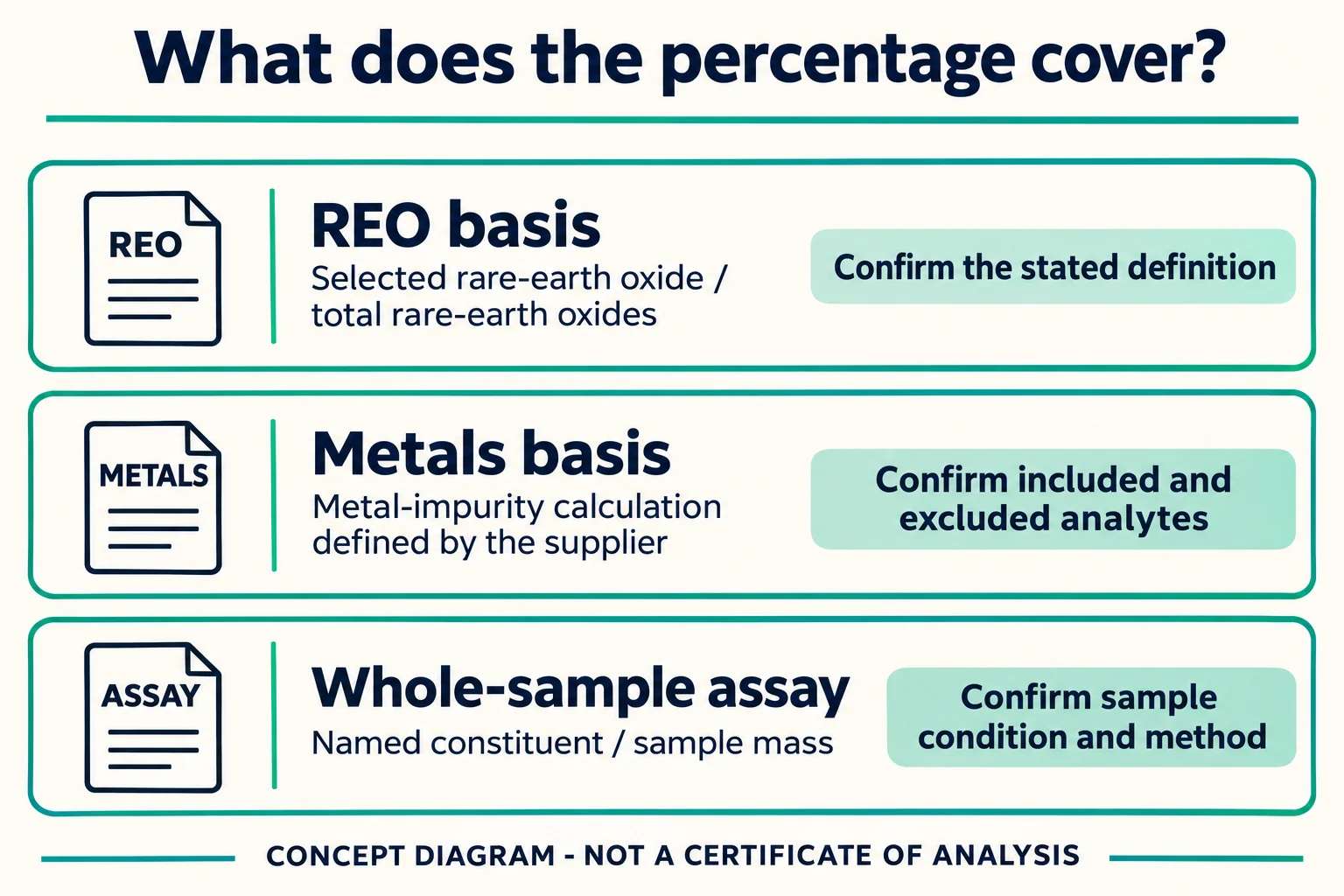
In its reference library, Stanford Materials describes REO-basis purity as the selected rare-earth oxide divided by total rare-earth oxides, or TREO. Confirm that definition on the quotation or certificate; an unexplained abbreviation is insufficient. Source: Stanford Materials, rare-earth purity conventions.
| Reported label | What it describes | What still needs clarification |
|---|---|---|
| REO basis, where defined as REO/TREO | The selected oxide’s share of the total rare-earth-oxide accounting basis. | Total TREO relative to the sample, other impurities, and whether values are reported as oxide equivalents. |
| Metals basis | A purity calculation based on the supplier’s stated metal-impurity scope. | The calculation, analyte list, exclusions and reporting units; any separately required nonmetal results. |
| Whole-sample assay | The amount of a named constituent relative to the defined sample mass. | As-received or conditioned basis, analytical method, uncertainty where relevant, and whether the result is elemental or compound-equivalent. |
Also distinguish metals basis from rare-earth-metal basis, which can mean one rare-earth metal relative to total rare-earth metals. Request the written calculation for either expression. Source: rare-earth-metal basis definition.
Thermo Fisher’s high-purity materials reference describes its purity values as typically based on total metallic impurities. Confirm the calculation used for the offered target. A metals-basis number alone cannot establish oxygen, carbon, nitrogen or hydrogen limits; obtain explicit coverage for any of those that matter to the order. Source: Thermo Fisher, purity levels FAQ.
A relative purity number can exceed the whole-sample fraction
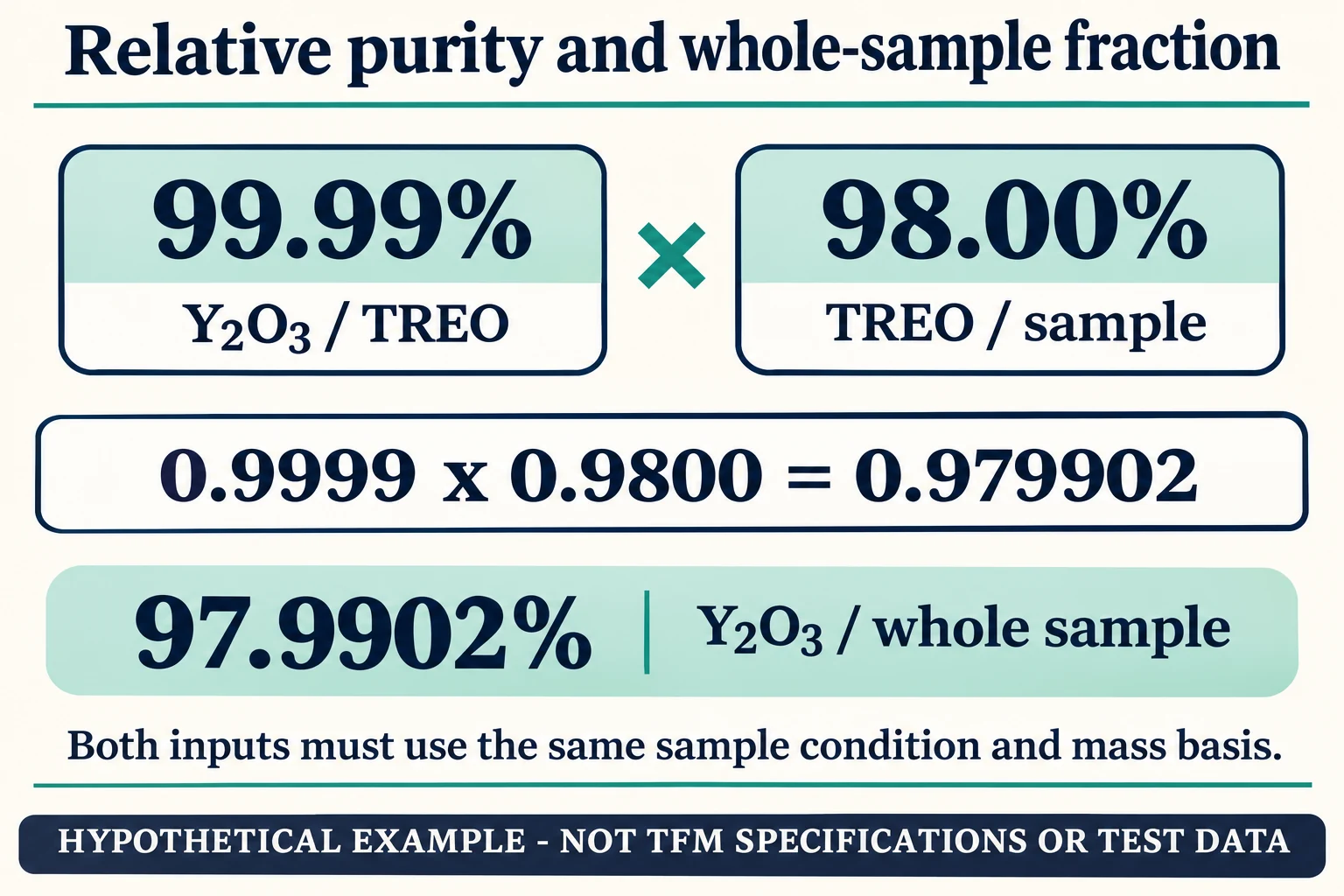
Consider a hypothetical report with Y2O3/TREO = 99.99% and TREO/sample = 98.00%. Assume both entries use the same prepared sample, mass basis and oxide accounting convention. Multiplying the fractions gives:
0.9999 × 0.9800 = 0.979902 = 97.9902%
The calculated Y2O3-equivalent content is about 97.99% of the sample on those assumptions. The extra digits show the arithmetic only; the hypothetical inputs are not TFM specifications or test results. This calculation follows the relative-to-total relationship described in the supplier reference library.
The unassigned balance remains unidentified. An oxide-equivalent calculation also leaves crystalline phases unresolved, so request separate phase evidence when the order requires it. If the two percentages use different conditioning or analytical bases, resolve the mismatch before multiplying them.
Why oxygen in Y₂O₃ is not automatically an impurity
Yttrium oxide contains oxygen by its formula. Using atomic weights of 88.905838 for Y and a rounded 15.999 for O, the ideal stoichiometric oxygen mass fraction is:
3 × 15.999 / (2 × 88.905838 + 3 × 15.999) × 100% ≈ 21.26 wt%
CIAAW lists the yttrium value and an oxygen standard atomic-weight interval of 15.99903–15.99977. The rounded oxygen value above is sufficient for this illustration. CIAAW: yttrium; CIAAW: oxygen.
That 21.26 wt% is calculated from an ideal formula, not measured on a target. It cannot verify a supplied target’s oxygen stoichiometry, phase composition or purity. For an yttrium metal order, request a separately stated oxygen requirement if needed. For Y2O3, distinguish intended oxygen from unwanted constituents and from any departure from the required composition.
Apply the same identity check before reviewing a lanthanum oxide target quotation. A high metals-basis purity claim alone does not determine whether an oxide meets a specified composition or phase requirement.
Put the basis and evidence request in the RFQ
A statement such as “4N target” is incomplete when the acceptance basis remains undefined. Send the supplier the formula and grade wording you intend to purchase, then ask which records can substantiate the requirement for the offered material.
| RFQ field | Request |
|---|---|
| Material identity | Specify metal, oxide or named compound, with formula and intended composition. Keep purity and composition as separate requirements. |
| Purity calculation | State the numerator and denominator, the included impurity list, and how unreported or below-limit results are handled. |
| Nonmetal coverage | List any required O, C, N or H results separately, with agreed limits and methods. Do not import a metal impurity limit into an oxide composition requirement. |
| Sample and units | Identify the sampled material and condition. State units, such as µg/g for mass-based impurity values where applicable. |
| Traceability | Ask whether the result belongs to feedstock, an intermediate or the finished target, and how the record connects to the supplied item or lot. |
| Other acceptance records | Specify any separately required phase, density, dimension or bonding evidence. A purity percentage cannot substitute for these records. |
Check the scope of a cited method too. The published abstract for ISO 23596:2023 describes a gravimetric rare-earth-content method for specified metals and compounds, with stated determination ranges and exclusions. Citing that standard alone does not establish a target’s 4N purity. Ask which analyte, matrix and range the reported method covers. Source: ISO 23596:2023, public scope.
Use TFM’s sputtering target CoA review guide for the wider certificate check, including identifiers and supporting reports.
Questions about rare-earth target purity
Can I compare two targets that both say 99.99%?
Confirm that their material identities, calculation bases, impurity coverage and sample conditions match. Resolve any differences before treating the purity claims as equivalent.
Does REO-basis purity give the selected oxide’s whole-sample fraction?
That calculation also needs a TREO-to-sample value. Confirm both definitions and a common mass basis first; use the same oxide accounting convention.
Does high target purity guarantee the deposited film composition?
A target purity statement does not specify the film composition or qualify a deposition process. Keep film acceptance criteria and process validation separate from target chemical acceptance.
Send the formula and purity wording with your inquiry
If you are still choosing the material form, start with the rare-earth sputtering target range. For a specific order, send TFM your target requirements with the formula, dimensions or drawing, quantity, requested purity basis, critical impurities and required reports. Mark any acceptance points that still need agreement.
Visuals are generated concept illustrations, not actual TFM product photographs or test data.