Introduction
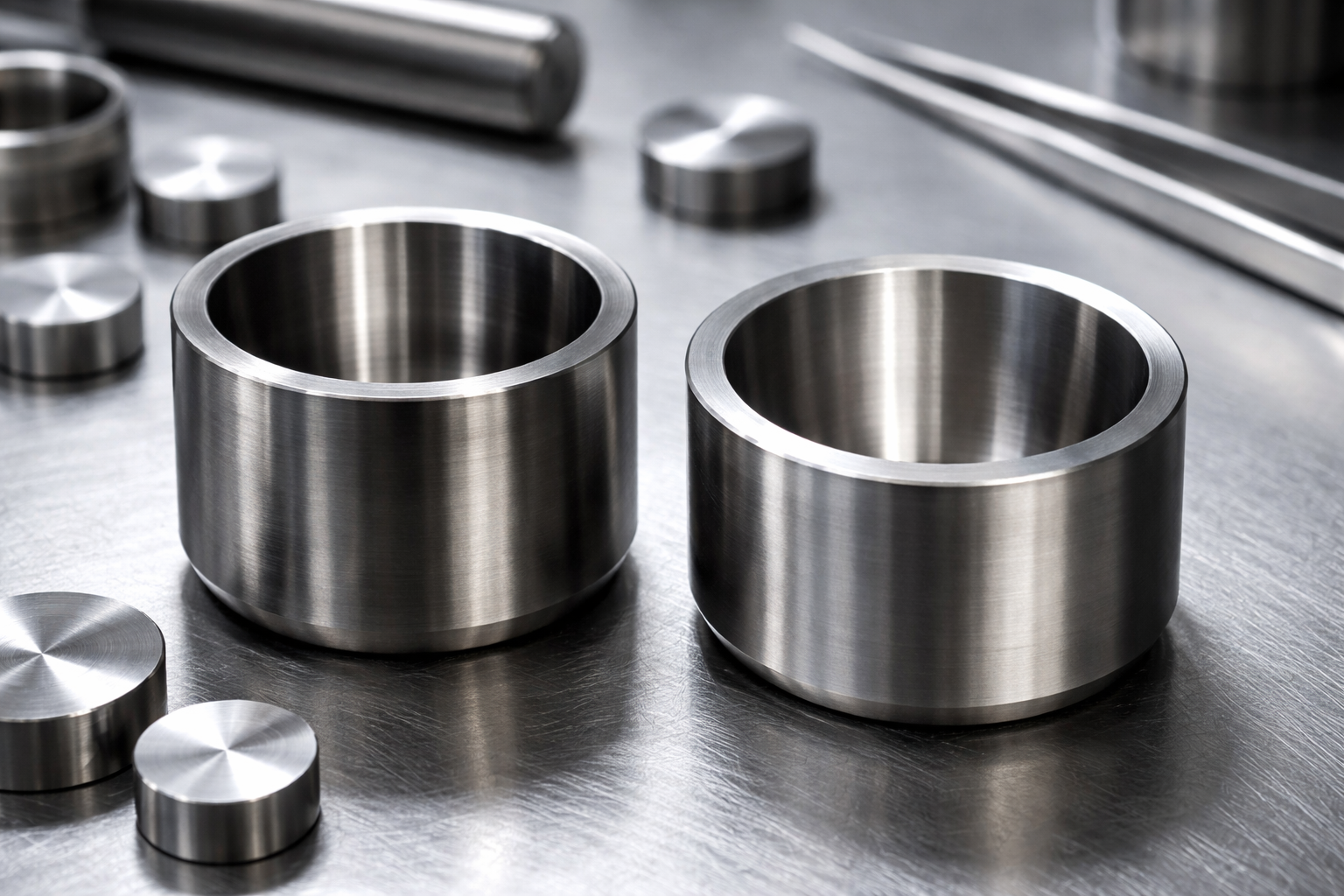
Crucibles made from refractory metals play a critical role in industries that operate under extreme temperatures and controlled atmospheres. Among them, tungsten crucibles and molybdenum crucibles are two of the most widely used options for high-temperature processing, crystal growth, vacuum furnaces, and advanced materials research.
Both materials belong to the group of refractory metals known for their exceptional melting points, mechanical strength at elevated temperatures, and chemical stability in vacuum or inert atmospheres. However, despite these similarities, tungsten and molybdenum crucibles differ significantly in terms of temperature capability, cost, oxidation behavior, and industrial suitability.
Understanding these differences is essential for engineers, researchers, and procurement specialists who must choose the most suitable crucible for a specific thermal process. This article provides a detailed comparison of tungsten and molybdenum crucibles, including their properties, performance under extreme conditions, and guidelines for selecting the right material.
What Are Tungsten Crucibles?
Tungsten crucibles are containers manufactured from high-purity tungsten metal, typically using powder metallurgy techniques such as cold isostatic pressing (CIP), sintering, and precision machining. Tungsten is known for having the highest melting point among all metals, reaching 3422 °C, which makes it ideal for ultra-high-temperature applications.
These crucibles are widely used in environments where conventional materials would fail due to thermal deformation, chemical reactions, or vaporization.
Key Characteristics of Tungsten Crucibles
- Extremely high melting point (3422 °C)
- Excellent mechanical strength at elevated temperatures
- Low vapor pressure at high temperatures
- High density and structural stability
- Good compatibility with many high-temperature materials
Because of these properties, tungsten crucibles are commonly used in:
- Sapphire crystal growth
- Rare earth metal melting
- Semiconductor material processing
- Thermal evaporation systems
- Aerospace material manufacturing
Tungsten crucibles are especially valuable in applications where temperatures exceed 2000 °C, where most other metals lose mechanical integrity.
What Are Molybdenum Crucibles?
Molybdenum crucibles are manufactured from high-purity molybdenum metal, another refractory material widely used in vacuum furnaces and high-temperature equipment. Molybdenum has a melting point of 2623 °C, which is lower than tungsten but still far higher than most industrial metals.
Due to its combination of high temperature resistance and relatively lower cost, molybdenum crucibles are commonly used in many thermal processing systems.
Key Characteristics of Molybdenum Crucibles
- High melting point (2623 °C)
- Excellent thermal conductivity
- Lower density compared with tungsten
- Good mechanical strength at elevated temperatures
- Lower cost compared to tungsten components
Typical applications include:
- Vacuum sintering
- Glass melting
- Rare earth oxide processing
- Semiconductor manufacturing
- Metallurgical experiments
For processes operating between 1200 °C and 2000 °C, molybdenum crucibles often provide an effective balance between performance and cost.
Fundamental Material Property Comparison
Understanding the intrinsic material properties of tungsten and molybdenum is the first step toward selecting the appropriate crucible material.
| Property | Tungsten | Molybdenum |
|---|---|---|
| Melting Point | 3422 °C | 2623 °C |
| Density | 19.3 g/cm³ | 10.28 g/cm³ |
| Thermal Conductivity | ~170 W/m·K | ~138 W/m·K |
| Coefficient of Thermal Expansion | Low | Low |
| Vapor Pressure | Extremely low | Low |
| High Temperature Strength | Excellent | Very good |
From this comparison, it is clear that tungsten offers superior performance in extreme temperature environments, while molybdenum provides adequate performance for slightly lower temperature ranges.
High-Temperature Performance
Tungsten Crucibles
Tungsten maintains exceptional mechanical strength at temperatures above 2000 °C, which allows crucibles to retain their shape and structural stability even during prolonged high-temperature exposure.
In ultra-high-temperature furnaces, tungsten crucibles can operate close to 2500 °C or higher, especially in vacuum or inert gas environments.
Molybdenum Crucibles
Molybdenum crucibles perform very well up to approximately 1800 °C to 2000 °C, beyond which creep deformation and structural weakening may occur.
Therefore, molybdenum crucibles are often preferred for moderate high-temperature processes where tungsten’s extreme capability is unnecessary.
Oxidation Behavior
Both tungsten and molybdenum are susceptible to oxidation at elevated temperatures when exposed to air.
Tungsten
- Begins oxidizing around 400–500 °C
- Rapid oxidation occurs above 600 °C in air
- Must be used in vacuum or inert atmosphere
Molybdenum
- Oxidizes at temperatures above ~400 °C
- Forms volatile molybdenum oxides at high temperature
- Also requires vacuum or protective atmospheres
For this reason, both materials are primarily used in vacuum furnaces, inert gas environments, or hydrogen atmospheres.
Industrial Applications
Although both materials are used in similar industries, certain applications strongly favor one over the other.
Applications of Tungsten Crucibles
- Sapphire crystal growth (LED industry)
- Gallium oxide crystal production
- Rare earth metal melting
- Thermal evaporation for thin film deposition
- Aerospace alloy processing
- High-temperature plasma research
Applications of Molybdenum Crucibles
- Vacuum sintering
- Metal powder processing
- Rare earth oxide melting
- Semiconductor wafer manufacturing
- Laboratory high-temperature experiments
- Metallurgical refining
In general, tungsten crucibles dominate ultra-high-temperature environments, while molybdenum crucibles serve as versatile tools for slightly lower temperature processes.
Cost and Manufacturing Considerations
Cost is another important factor when choosing between tungsten and molybdenum crucibles.
Tungsten Crucibles
- Higher raw material cost
- More difficult machining due to high hardness
- Greater density increases material consumption
- Longer processing time
However, their longer service life in extreme environments can offset the initial investment.
Molybdenum Crucibles
- Lower raw material cost
- Easier machining
- Lower density reduces weight
- Widely available
For applications where temperatures remain below 2000 °C, molybdenum crucibles often provide a more economical solution.
How to Choose the Right Crucible
Selecting the right crucible requires evaluating several key parameters.
1. Operating Temperature
This is the most critical factor.
| Temperature Range | Recommended Material |
|---|---|
| Below 1800 °C | Molybdenum |
| 1800–2200 °C | Molybdenum or Tungsten |
| Above 2200 °C | Tungsten |
2. Chemical Compatibility
Some materials react differently with tungsten and molybdenum. The compatibility between the crucible material and the processed material must be carefully considered.
3. Atmosphere Conditions
Both materials require:
- Vacuum
- Argon
- Hydrogen
- Inert environments
They should not be used in oxidizing atmospheres at high temperature.
4. Mechanical Stability Requirements
For processes involving:
- long thermal cycles
- heavy loads
- extreme temperatures
tungsten crucibles are generally more reliable.
5. Budget Constraints
When temperature requirements allow, molybdenum crucibles provide significant cost savings.
Conclusion
Both tungsten and molybdenum crucibles are indispensable materials for high-temperature industrial processes and advanced scientific research. Their shared classification as refractory metals gives them exceptional thermal stability and compatibility with vacuum environments.
However, their performance differs significantly in key areas. Tungsten crucibles offer superior performance in ultra-high-temperature applications, thanks to their unmatched melting point and mechanical strength. In contrast, molybdenum crucibles provide an excellent balance of performance and cost for moderate high-temperature processes.
When selecting a crucible material, engineers should consider operating temperature, chemical compatibility, atmospheric conditions, and budget requirements. By carefully evaluating these factors, it becomes possible to choose the most efficient and reliable solution for a given thermal process.
For specialized applications such as crystal growth, semiconductor processing, and vacuum deposition, high-purity tungsten and molybdenum crucibles continue to play a vital role in enabling advanced materials technologies.
For detailed specifications or custom crucible designs, please contact sales@thinfilmmaterials.com for further technical assistance.