Introduction
In advanced thin film engineering, achieving durable adhesion between dissimilar materials remains one of the most critical challenges. Whether depositing gold on glass, platinum on silicon dioxide, or multilayer metal stacks in microelectronics, poor interfacial bonding often leads to delamination, cracking, or electrical instability.
Among various adhesion-promoting materials, Chromium (Cr) has consistently proven to be one of the most reliable and versatile solutions in Physical Vapor Deposition (PVD) systems. Its interfacial chemistry, mechanical compatibility, and stable oxide formation make it a preferred adhesion layer in semiconductor devices, optical coatings, MEMS structures, and decorative films.
This article examines, from a materials science perspective, why chromium remains the industry benchmark adhesion layer.
1. The Adhesion Challenge in Thin Film Systems
Thin films often involve stacking metals onto inert or low-surface-energy substrates such as:
- Glass
- Silicon dioxide (SiO₂)
- Sapphire
- Polymers
- Ceramics
Noble metals like Au, Ag, and Pt exhibit poor wetting behavior on oxide surfaces. Without an adhesion layer, deposited films may:
- Peel under thermal cycling
- Fail under mechanical stress
- Show poor step coverage
- Develop micro-cracks
An effective adhesion layer must:
- Chemically bond to the substrate
- Bond strongly to the overlayer
- Maintain stability during processing
- Remain thin enough not to interfere electrically or optically
Chromium satisfies all four criteria.
2. Why Chromium Bonds So Well: Interfacial Chemistry
2.1 Strong Chemical Affinity to Oxygen
Chromium has a strong affinity for oxygen and readily forms a stable chromium oxide (Cr₂O₃) at the interface.
When deposited onto glass or SiO₂:
- Chromium partially reacts with surface oxygen
- A chemically bonded interfacial layer forms
- This layer acts as an anchor between substrate and metal film
This chemical interaction is far stronger than the van der Waals forces that noble metals rely on.
2.2 Metallic Bonding with Overlayers
Chromium also bonds effectively with:
- Gold (Au)
- Silver (Ag)
- Platinum (Pt)
- Copper (Cu)
This dual bonding mechanism—oxide bonding below and metallic bonding above—is what makes chromium uniquely effective.
3. Mechanical Compatibility and Film Stress Control
3.1 Thermal Expansion Matching
Thin film systems frequently undergo thermal cycling during:
- Lithography baking
- Annealing
- Soldering
- High-temperature operation
Chromium’s coefficient of thermal expansion is moderate, allowing it to act as a buffer between materials with different expansion rates.
This reduces:
- Interfacial shear stress
- Crack propagation
- Film warping
3.2 Dense Microstructure
Chromium films deposited via:
- Thermal evaporation
- Electron beam evaporation
- Magnetron sputtering
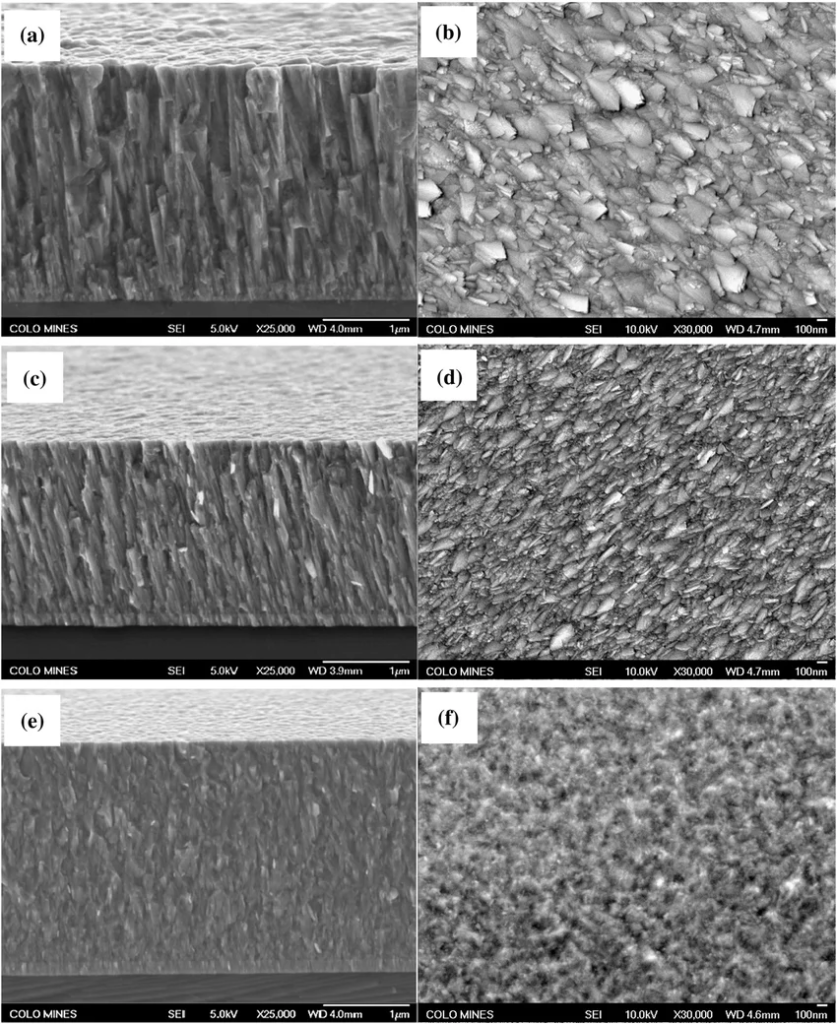
form relatively dense and fine-grained structures. This microstructure enhances:
- Mechanical stability
- Barrier performance
- Surface smoothness
4. Electrical and Optical Compatibility
An adhesion layer must not significantly alter device performance.
4.1 Electrical Considerations
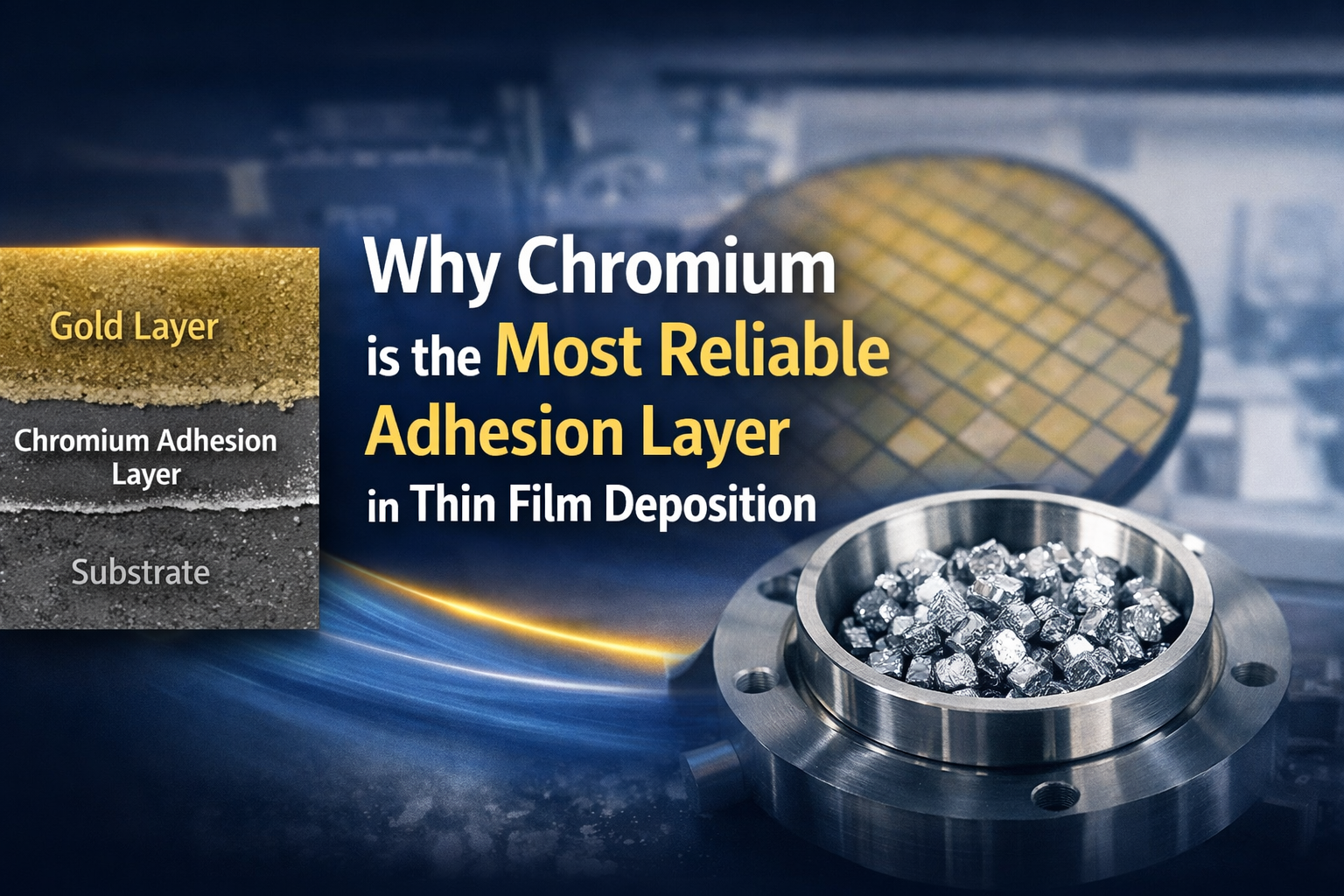
Chromium has moderate electrical resistivity (~12.9 µΩ·cm), higher than copper or gold but acceptable when used in ultrathin layers (5–20 nm).
Typical stack example:
- 10 nm Cr
- 100–200 nm Au
Because the chromium layer is extremely thin, electrical impact is minimal.
4.2 Optical Applications
In optics:
- Cr is often used under gold mirrors
- Provides strong adhesion without excessive optical absorption when thin
In decorative coatings, chromium can also serve as:
- Reflective base layer
- Protective underlayer
5. Chromium vs Titanium: A Technical Comparison
Titanium (Ti) is often considered an alternative adhesion layer. Below is a technical comparison:
| Property | Chromium (Cr) | Titanium (Ti) |
|---|---|---|
| Oxide Stability | Forms stable Cr₂O₃ | Forms TiO₂ (very reactive) |
| Oxygen Affinity | Strong | Very strong |
| Film Stress | Moderate | Often higher stress |
| Electrical Resistivity | ~12.9 µΩ·cm | ~42 µΩ·cm |
| Diffusion into Au | Low | Higher risk |
| Etching Behavior | Well-established | Also established |
Key Differences
- Titanium oxidizes more aggressively, which may complicate process control.
- Chromium shows better long-term dimensional stability in many Au/Cr stacks.
- Chromium diffusion behavior is generally more predictable.
For MEMS and microfabrication, Cr is often preferred when dimensional precision matters.
6. Process Considerations for Chromium Adhesion Layers
6.1 Deposition Methods
Chromium can be deposited via:
- Thermal evaporation
- Electron beam evaporation
- DC magnetron sputtering
Evaporation is widely used when:
- Simple metal stacks are required
- Low contamination is critical
- High purity chromium (3N–5N) is used
6.2 Recommended Thickness
Typical adhesion layer thickness:
- 5–20 nm for microelectronics
- 20–50 nm for mechanical durability
Excessively thick Cr layers may:
- Increase stress
- Influence optical reflectivity
- Affect conductivity
6.3 Vacuum Requirements
Because chromium oxidizes readily, recommended base pressure:
- ≤ 5 × 10⁻⁶ Torr
Lower oxygen partial pressure improves:
- Film purity
- Electrical performance
- Adhesion consistency
7. Reliability Under Harsh Conditions
Chromium adhesion layers show excellent stability under:
- Thermal cycling
- Humidity exposure
- Mechanical bending
- Moderate chemical exposure
Cr₂O₃ is chemically stable and provides corrosion resistance in many environments.
8. Industrial Applications
Chromium adhesion layers are widely used in:
Semiconductor Manufacturing
- Contact pads
- Interconnect underlayers
- Barrier layers
MEMS Devices
- Sensor electrodes
- Micro-actuators
Optical Coatings
- Gold mirrors
- Reflective layers
Decorative Coatings
- Metalized plastics
- Architectural glass
9. Purity Matters in Chromium Evaporation Materials
Impurities such as:
- Oxygen
- Nitrogen
- Carbon
can influence:
- Film resistivity
- Grain growth
- Adhesion strength
For high-performance devices:
- 99.9% (3N) suitable for general use
- 99.99% (4N) preferred for semiconductor
- 99.999% (5N) for advanced R&D
High-purity chromium evaporation materials reduce defect density and improve repeatability.
Conclusion
Chromium’s reliability as an adhesion layer stems from a unique combination of:
- Strong chemical bonding with oxides
- Stable metallic bonding with noble metals
- Moderate film stress
- Predictable diffusion behavior
- Process compatibility across PVD platforms
While alternative materials exist, chromium continues to be the most balanced and widely adopted adhesion layer in thin film deposition systems.
For applications requiring consistent interfacial performance, dimensional stability, and long-term reliability, chromium remains the industry benchmark.