Bismuth Chromium Oxide Sputtering Target, commonly written as BiCrO3 Target, is an advanced oxide ceramic target used for preparing bismuth chromium oxide thin films by physical vapor deposition. As research in multifunctional oxides, perovskite-related materials, ferroelectric thin films, magnetic oxides, and complex oxide electronics continues to expand, BiCrO3 has attracted attention as a promising material for experimental and high-performance thin film applications.
Compared with common single-metal or binary oxide targets, BiCrO3 belongs to the category of complex oxide sputtering targets. Its value lies not only in its chemical composition, but also in the ability to transfer a controlled Bi-Cr-O system onto substrates under carefully designed deposition conditions. For laboratories, universities, semiconductor research groups, and advanced coating developers, a reliable BiCrO3 sputtering target is essential for obtaining consistent film composition, stable plasma behavior, and repeatable experimental results.
What Is a BiCrO3 Sputtering Target?
A BiCrO3 sputtering target is a ceramic target composed of bismuth, chromium, and oxygen in a designed oxide composition. It is typically produced through powder processing, mixing, pressing, sintering, and precision machining. Because bismuth-containing oxides may be sensitive to processing conditions, careful control of raw material purity, particle size, sintering temperature, and final machining is important.
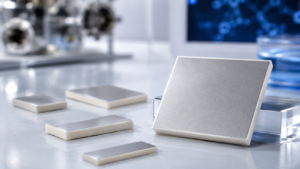
The target is usually supplied in disc, plate, rectangular, or custom geometries depending on the sputtering system. Standard sizes include 1 inch, 2 inch, 3 inch, 4 inch, 5 inch, and 6 inch diameter targets, while customized thickness, backing plate bonding, and special dimensions can also be provided for research or industrial deposition systems.
For RF sputtering, BiCrO3 ceramic targets are commonly used because oxide materials are generally insulating or semiconducting. Depending on the equipment and film requirements, the target may be bonded to a copper backing plate using indium or elastomer bonding to improve heat transfer and mechanical stability during sputtering.
Key Material Features of BiCrO3 Target
BiCrO3 Target is mainly selected for complex oxide thin film research. The presence of bismuth and chromium gives the material a unique position among functional oxide systems. In thin film studies, Bi-Cr-O based materials may be investigated for dielectric, ferroelectric, magnetic, optical, and electronic properties.
Several target characteristics directly influence deposition performance:
Composition control:
Complex oxide films require stable elemental transfer during sputtering. A well-manufactured BiCrO3 target helps reduce large composition deviations and improves film repeatability.
High-purity raw materials:
Typical purity can be 99.9% to 99.99%, depending on project requirements. Higher purity is especially important for electronic, optical, and research-grade thin film applications where trace impurities may affect film behavior.
Dense ceramic structure:
A target with good density and uniform microstructure helps reduce arcing, particle generation, and abnormal erosion during sputtering.
Machined surface quality:
A flat, clean, and precisely machined surface supports stable plasma formation and uniform sputtering.
Custom bonding options:
Indium bonding provides excellent thermal conductivity, while elastomer bonding may be preferred for targets or applications requiring lower bonding temperature or improved stress tolerance.
Typical Specifications
| Parameter | Typical Value / Range | Importance |
|---|---|---|
| Product Name | Bismuth Chromium Oxide Sputtering Target | Used for BiCrO3 thin film deposition |
| Chemical Formula | BiCrO3 | Defines the target composition |
| Purity | 99.9% – 99.99% | Higher purity supports cleaner thin films |
| Shape | Disc, plate, rectangle, custom shape | Matches different sputtering systems |
| Diameter | 1” – 14” or customized | Compatible with common target holders |
| Thickness | 0.125”, 0.25”, or customized | Influences lifetime and heat behavior |
| Density | Customized / process-dependent | Affects sputtering stability |
| Bonding | Indium or elastomer bonding | Improves thermal transfer and target support |
| Backing Plate | Copper, molybdenum, titanium, or custom | Selected based on system design |
| Application Method | RF sputtering recommended | Suitable for oxide ceramic targets |
Applications of BiCrO3 Target
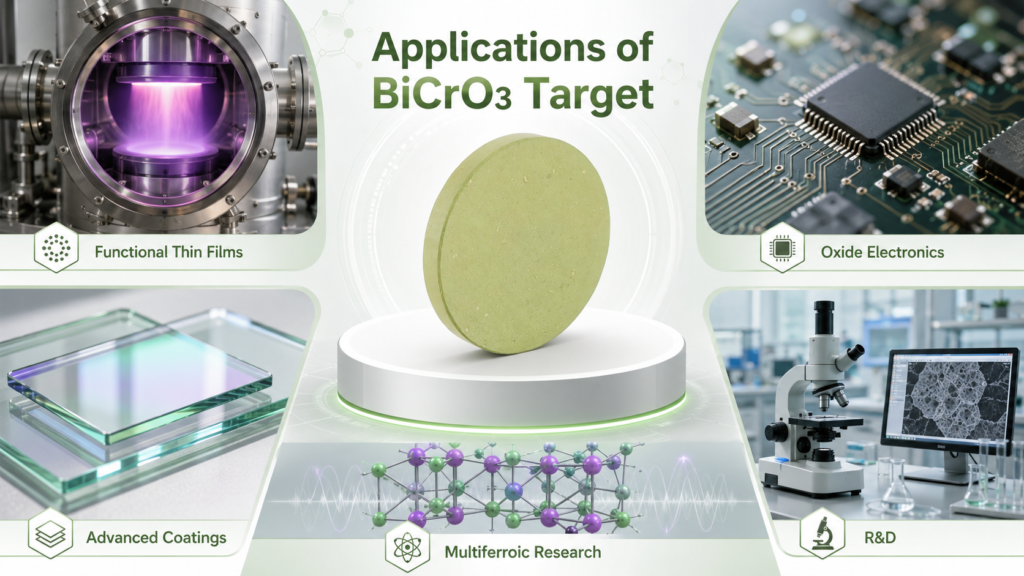
BiCrO3 sputtering targets are mainly used in advanced thin film research and functional oxide coating development. Typical application areas include:
Complex oxide thin films
BiCrO3 is suitable for preparing Bi-Cr-O based films for academic and industrial research involving multifunctional oxide materials.
Ferroelectric and dielectric material studies
Bismuth-based oxides are often studied in relation to polarization, dielectric response, and functional electronic behavior. BiCrO3 targets may be used in thin film experiments where controlled oxide composition is required.
Magnetic oxide research
Chromium-containing oxides can be relevant in magnetic and spin-related material studies. BiCrO3 films may be investigated in experimental work involving multiferroic or magnetoelectric oxide systems.
Optical and electronic coatings
Bi-Cr-O films may be explored for optical, electronic, or sensor-related applications, depending on deposition parameters, substrate selection, and post-deposition treatment.
University and R&D laboratories
Because BiCrO3 is a specialized complex oxide, it is commonly used by research institutions, thin film laboratories, and advanced materials development teams rather than general coating factories.
Comparison with Related Oxide Targets
| Material | Key Feature | Typical Application |
| BiCrO3 Target | Complex bismuth chromium oxide composition | Functional oxide thin films, multiferroic-related research |
| BiFeO3 Target | Well-known bismuth ferrite oxide system | Ferroelectric, magnetic, and multifunctional oxide films |
| Cr2O3 Target | Stable chromium oxide material | Protective coatings, optical films, hard coatings |
| Bi2O3 Target | Bismuth-rich oxide source | Optical, dielectric, and oxide film research |
| LaCrO3 Target | Perovskite-type chromium oxide | Conductive ceramic, oxide electronics, high-temperature films |
This comparison shows that BiCrO3 is not a general-purpose oxide target. Its main value is in specialized functional oxide research where bismuth and chromium chemistry are required in the same thin film system.
Manufacturing and Quality Considerations
Producing a reliable BiCrO3 target requires more than simply mixing oxide powders. The manufacturing process must consider stoichiometry, powder homogeneity, sintering behavior, density, brittleness, and machining tolerance.
A typical production route may include:
- Selection of high-purity bismuth and chromium oxide raw materials
- Controlled powder mixing and milling
- Pressing into green body form
- High-temperature sintering under suitable atmosphere
- Precision machining to final size
- Cleaning, inspection, and packaging
- Optional bonding to backing plate
For research-grade sputtering targets, inspection is especially important. Dimensional tolerance, surface flatness, visible defects, edge chipping, and bonding integrity should be checked before shipment. For bonded targets, void-free bonding and good thermal contact help reduce cracking risk during sputtering.
How to Select the Right BiCrO3 Target
When requesting a BiCrO3 target, buyers should specify more than just the material name. The following details help ensure the target is suitable for the intended system:
- Target diameter and thickness
- Required purity
- Whether bonding is needed
- Backing plate material and dimensions
- Sputtering system model or target holder design
- Deposition method, usually RF sputtering
- Required density or relative density, if specified
- Quantity and delivery schedule
- Special tolerance or surface finish requirements
For early-stage research, a 1 inch or 2 inch disc target is often sufficient. For pilot-scale deposition or larger coating systems, 3 inch, 4 inch, 6 inch, or custom rectangular targets may be required.
Packaging
Our BiCrO3 Sputtering Targets are carefully cleaned, protected, tagged, and labeled externally to ensure efficient identification and quality control. Each target is packed with protective materials to reduce the risk of edge damage, cracking, contamination, or moisture exposure during storage and transportation. For bonded targets or fragile ceramic targets, reinforced packaging can be arranged according to export shipping requirements.
FAQ
| Question | Answer |
| Can BiCrO3 targets be customized? | Yes. Diameter, thickness, purity, shape, tolerance, and bonding can be customized according to the sputtering system. |
| Is BiCrO3 suitable for DC sputtering? | RF sputtering is usually preferred for oxide ceramic targets because many oxide materials are insulating or have limited conductivity. |
| Can the target be bonded to a backing plate? | Yes. Indium bonding and elastomer bonding are commonly available depending on target size, material behavior, and operating conditions. |
| What purity is available? | Typical purity ranges from 99.9% to 99.99%, depending on raw material availability and project requirements. |
| What information is needed for quotation? | Please provide material, purity, diameter, thickness, quantity, bonding requirement, backing plate drawing if needed, and delivery destination. |
Conclusion
BiCrO3 Target is a specialized complex oxide sputtering target designed for advanced thin film deposition and functional oxide research. Its controlled bismuth chromium oxide composition makes it suitable for laboratories and engineering teams working on ferroelectric, dielectric, magnetic, optical, and multifunctional oxide films.
For best deposition results, buyers should pay attention to target purity, density, size, bonding method, and sputtering system compatibility. A properly manufactured BiCrO3 sputtering target can improve process stability, reduce defects, and support repeatable thin film development.
For detailed specifications and a quotation, please contact us at sales@thinfilmmaterials.com.