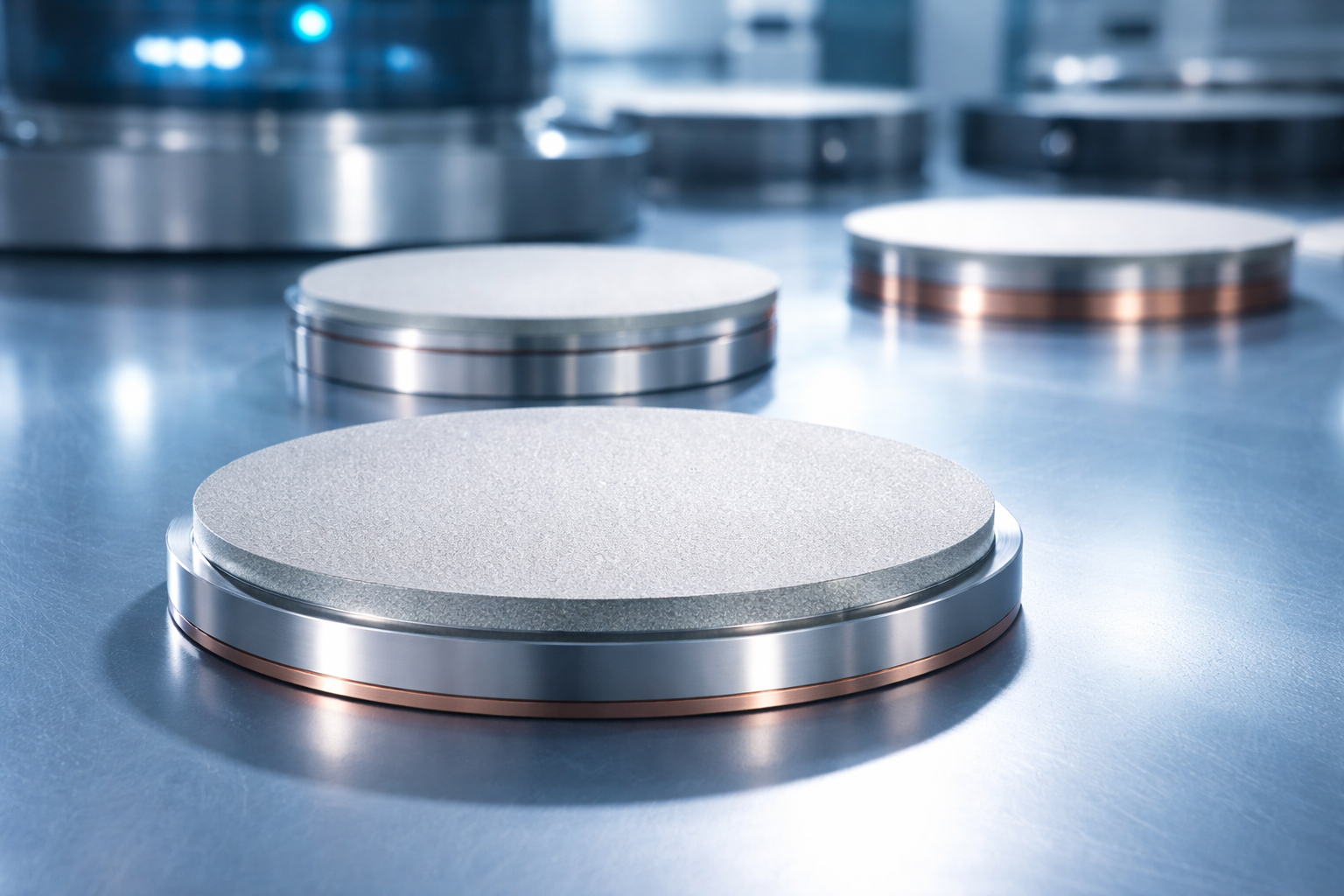
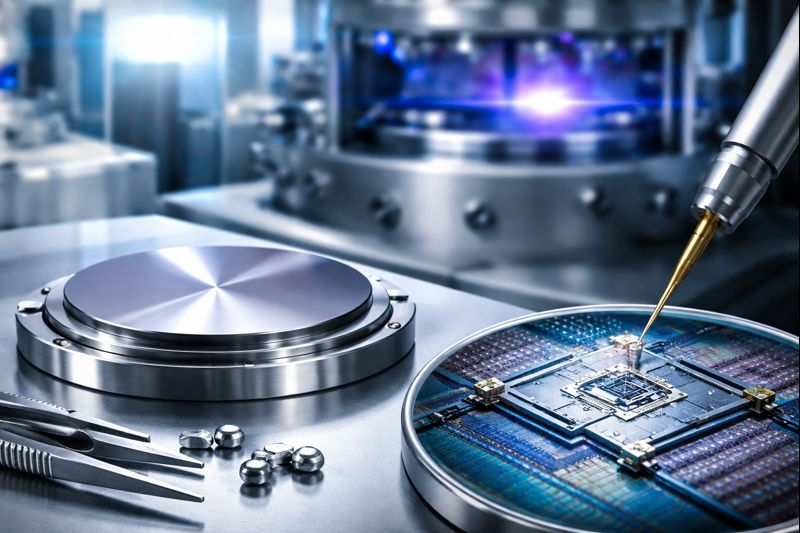
In the world of thin-film materials, most sputtering targets are chosen for relatively “passive” roles. Aluminum provides conductivity, chromium improves adhesion, tantalum ensures barrier performance, and oxides shape optical behavior. Iron Gallium (Fe/Ga) sputtering targets belong to a very different category. They are not selected simply because they deposit well or because they are chemically stable, but because they actively respond to magnetic and mechanical stimuli.
Fe/Ga sits at the intersection of materials physics, magnetism, and micro-scale engineering. When deposited as a thin film, it does not merely exist on the substrate—it moves, responds, and interacts with its environment. This makes Iron Gallium one of the most fascinating functional alloy systems used in sputtering today.
This article explores Iron Gallium sputtering targets not as a catalog item, but as a materials platform—from its physical origins and thin-film behavior to why engineers increasingly choose Fe/Ga when they need materials that do more than just sit still.
1. Iron Gallium: A Functional Alloy, Not a Conventional Metal
At first glance, Iron Gallium may look unremarkable. It is metallic, silver-gray, and compositionally simple. Yet this simplicity is deceptive.
Pure iron is already a magnetic material, but its magnetostrictive response—the ability to change shape under a magnetic field—is modest. Gallium, on the other hand, is a non-magnetic, low-melting metal. When alloyed together in carefully controlled ratios, gallium dramatically alters the internal crystal behavior of iron.
The result is an alloy family often referred to as Galfenol, known for combining:
High magnetostriction
Mechanical toughness
Machinability and thin-film compatibility
Absence of brittle rare-earth elements
This combination is rare. Many high-performance magnetostrictive materials rely on rare earths and suffer from brittleness or processing difficulty. Iron Gallium avoids these drawbacks, which is why it has transitioned from academic curiosity to practical thin-film material.
2. Why Gallium Changes Everything: The Physics Behind Fe/Ga
The key to Iron Gallium’s behavior lies in lattice distortion.
Gallium atoms are larger than iron atoms. When Ga substitutes into the iron lattice, it introduces localized strain fields. These distortions are not random—they interact strongly with the magnetic domains inside the material.
In simple terms:
- Magnetic domain rotation causes lattice deformation
- Mechanical stress influences magnetic orientation
This two-way coupling is known as magnetoelastic coupling, and Fe/Ga exhibits it strongly.
In thin films, this effect becomes even more pronounced because:
- Substrate constraint amplifies stress sensitivity
- Grain orientation can be engineered during deposition
- Residual stress becomes a design variable rather than a defect
Iron Gallium thin films therefore behave less like passive coatings and more like active layers.
3. Why Sputtering Matters for Iron Gallium
Bulk Iron Gallium alloys have been studied for decades, but sputtering unlocks an entirely new dimension of functionality.
Thin Films Enable Integration
Sputtered Fe/Ga films can be integrated directly onto:
- Silicon wafers
- MEMS structures
- Glass and ceramic substrates
- Metal diaphragms and resonators
This makes Iron Gallium compatible with microfabrication processes, lithography, and layered device architectures.
Composition Control at the Atomic Level
Using a sputtering target allows engineers to fine-tune:
- Ga concentration
- Film thickness (from nanometers to micrometers)
- Crystallographic texture
Small changes in composition can lead to significant differences in magnetostrictive response, coercivity, and stress sensitivity—making sputtering an ideal deposition method.
Stability Compared with Alternative Routes
Unlike electroplating or evaporation of low-melting gallium-rich systems, sputtering from a solid Fe/Ga target offers:
- Stable deposition rates
- Uniform composition across large substrates
- Repeatability essential for device development
4. Iron Gallium Thin Films vs. Traditional Magnetic Films
Iron Gallium thin films occupy a unique position between conventional soft magnetic films and exotic functional materials.
Compared with Pure Iron Films
Pure iron films are soft magnetic but magnetostrictively weak. They are suitable for magnetic cores and shielding but offer limited mechanical-magnetic coupling.
Fe/Ga films, by contrast:
- Exhibit much higher magnetostrictive strain
- Respond more strongly to stress
- Enable sensing and actuation, not just magnetism
Compared with Nickel and Permalloy
Nickel-based films are stable and well understood, but their magnetostrictive response is relatively small. Permalloy is excellent for low-loss magnetic applications but is intentionally engineered to minimize magnetostriction.
Iron Gallium goes in the opposite direction—it embraces magnetostriction as a feature.
Compared with Rare-Earth Magnetostrictive Materials
Materials like Terfenol-D offer extreme magnetostriction but are:
- Brittle
- Difficult to deposit as thin films
- Sensitive to processing defects
Fe/Ga sacrifices some peak performance in exchange for mechanical durability and manufacturability, which is often the smarter trade-off at micro and thin-film scales.
5. MEMS and Micro-Actuation: Where Fe/Ga Truly Shines
One of the most compelling application spaces for Iron Gallium thin films is MEMS.
In micro-scale systems, traditional actuation methods—electrostatic, thermal, or piezoelectric—each come with limitations. Magnetostrictive actuation using Fe/Ga introduces a different paradigm.
Why Fe/Ga Works in MEMS
- Thin films generate measurable strain at low magnetic fields
- Mechanical robustness supports cyclic loading
- Films can be patterned into beams, cantilevers, and membranes
This enables:
- Micro-actuators with fast response
- Resonant devices with tunable frequency
- Compact force and displacement generators
Fe/Ga turns magnetic fields into motion without requiring direct electrical contact, which is especially valuable in harsh or sealed environments.
6. Stress, Strain, and Sensing: A Material That Feels
Iron Gallium thin films are exceptionally sensitive to mechanical stress. This makes them ideal for stress and strain sensing applications.
When Fe/Ga films experience mechanical deformation:
- Magnetic permeability changes
- Domain orientation shifts
- Electrical or magnetic signals can be detected
This behavior supports applications such as:
- Torque sensors on rotating shafts
- Structural health monitoring
- Load sensing in compact assemblies
Unlike optical or piezoelectric sensors, Fe/Ga-based sensors can operate in environments with high temperature, vibration, or electromagnetic noise.
7. Energy Harvesting and Self-Powered Devices
Another area where Iron Gallium thin films attract attention is magnetostrictive energy harvesting.
Ambient vibrations—machinery motion, structural oscillations, or acoustic energy—are abundant but difficult to capture efficiently at small scales. Fe/Ga thin films enable devices that convert mechanical vibration into electrical energy via magneto-mechanical coupling.
While power output is modest, it is often sufficient for:
- Wireless sensor nodes
- Condition monitoring systems
- Low-power electronics in inaccessible locations
In this context, Fe/Ga is not competing with batteries but complementing them, extending service life and reducing maintenance.
8. Thin-Film Engineering: Texture, Stress, and Performance
Iron Gallium thin films are highly sensitive to how they are deposited.
Parameters such as:
- Sputtering power
- Working gas pressure
- Substrate temperature
- Post-deposition annealing
all influence:
- Grain size
- Crystallographic orientation
- Residual stress
Engineers often deliberately tune these factors to balance magnetostrictive response with mechanical stability. This tunability is one reason Fe/Ga remains an active research topic rather than a “solved” material.
9. Why Researchers and Engineers Keep Coming Back to Fe/Ga
Despite decades of study, Iron Gallium continues to attract attention because it sits at a rare intersection:
- Physically rich enough to explore new phenomena
- Practical enough to manufacture and integrate
- Robust enough for real-world devices
Every improvement in deposition control or device architecture unlocks new possibilities. Fe/Ga is not a material with a single “killer application”; it is a toolkit material that adapts to different design goals.
10. Looking Forward: The Future of Iron Gallium Thin Films
As devices continue to shrink and expectations grow, materials that can sense, move, and respond will become increasingly valuable.
Iron Gallium sputtered thin films are well positioned for this future because they:
- Avoid reliance on scarce rare-earth elements
- Integrate with semiconductor and MEMS processes
- Offer tunable functional performance
From smart sensors and adaptive RF components to self-powered microsystems, Fe/Ga represents a shift in how engineers think about metallic thin films—not as static layers, but as active participants in device behavior.
Final Thoughts
Iron Gallium sputtering targets are not interesting because they are exotic. They are interesting because they are useful in subtle, powerful ways. They reward careful engineering, thoughtful deposition, and creative device design.
In an industry often dominated by incremental improvements, Fe/Ga stands out as a reminder that sometimes, changing the alloy just a little can change the entire way a material behaves.