

Introduction
The Manganese Sulfide (MnS) Sputtering Target is a specialized deposition material widely used in thin film technologies, particularly in semiconductor research, optoelectronics, and functional coatings. MnS belongs to a class of transition-metal sulfide materials that exhibit unique electronic and optical properties, making them valuable for advanced thin-film applications.
In magnetron sputtering and other Physical Vapor Deposition (PVD) processes, MnS targets enable the formation of high-quality manganese sulfide thin films with controlled composition and microstructure. These films are frequently utilized in materials science research, electronic devices, and optical coatings due to their semiconductor behavior, tunable band structure, and compatibility with various substrates.
Detailed Description
Manganese Sulfide Sputtering Targets are manufactured using high-purity manganese and sulfur precursors through advanced powder metallurgy or hot-pressing techniques. These processes ensure uniform density, stable composition, and excellent sputtering performance during thin-film deposition.
MnS is typically supplied in stoichiometric form with high purity levels suitable for research and industrial deposition processes. The material exhibits good sputtering stability and relatively low vapor pressure under vacuum conditions, allowing consistent deposition rates and film uniformity.
The physical and chemical stability of MnS makes it compatible with RF magnetron sputtering, which is commonly used for sulfide ceramic targets. During deposition, MnS targets generate thin films with controlled stoichiometry, which is critical for applications requiring precise electronic or optical properties.
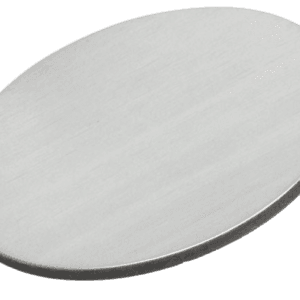
Typical sputtering targets are fabricated as disc, rectangular, or custom geometries depending on the sputtering system used. For improved thermal conductivity and mechanical stability, MnS targets can also be bonded to copper backing plates using indium bonding or elastomer bonding. This helps dissipate heat effectively and prolongs target lifetime during high-power sputtering operations.
High-density MnS targets reduce particle generation and improve deposition stability, which is essential in semiconductor and research environments where film uniformity and contamination control are critical.
Applications
Manganese sulfide thin films produced from MnS sputtering targets are used in several advanced technological fields:
Semiconductor research – used in experimental semiconductor structures and heterojunction materials.
Optoelectronic devices – MnS films exhibit optical and electronic properties suitable for sensors and photonic devices.
Magnetic and spintronic research – Mn-based compounds are studied for magnetic thin-film applications.
Protective and functional coatings – sulfide films can be used in specialized coatings with controlled electronic behavior.
Thin-film materials science – MnS is frequently used in academic and industrial research for studying transition metal sulfide materials.
Energy materials research – Mn-based sulfides are explored in battery and catalytic studies.
Technical Parameters
| Parameter | Typical Value / Range | Importance |
|---|---|---|
| Purity | 99.9% – 99.99% | Higher purity improves film uniformity and electrical performance |
| Density | ≥95% theoretical | Higher density improves sputtering stability |
| Diameter | 25 – 300 mm (custom) | Compatible with different sputtering systems |
| Thickness | 3 – 6 mm | Influences sputtering rate and target lifetime |
| Bonding | Copper backing plate (optional) | Enhances thermal conductivity and stability |
Comparison with Related Materials
| Material | Key Advantage | Typical Application |
|---|---|---|
| Manganese Sulfide (MnS) | Stable sulfide semiconductor | Semiconductor research and thin films |
| Zinc Sulfide (ZnS) | Excellent optical transparency | Optical coatings and infrared optics |
| Iron Sulfide (FeS) | Magnetic and catalytic properties | Catalysis and energy research |
FAQ
| Question | Answer |
|---|---|
| Can the MnS sputtering target be customized? | Yes, diameter, thickness, purity, and backing plate bonding can be customized according to sputtering system requirements. |
| What deposition method is recommended for MnS targets? | RF magnetron sputtering is typically recommended for sulfide ceramic targets to ensure stable plasma conditions. |
| Are bonded targets available? | Yes, MnS targets can be indium-bonded or elastomer-bonded to copper backing plates for improved heat dissipation. |
| What substrates are compatible with MnS thin films? | Common substrates include silicon wafers, glass, sapphire, and various oxide substrates used in research and semiconductor fabrication. |
| Which industries most commonly use MnS targets? | Semiconductor R&D, optoelectronics, advanced coatings, and academic research laboratories frequently use MnS sputtering targets. |
Packaging
Our Manganese Sulfide Sputtering Targets are meticulously tagged and labeled externally to ensure efficient identification and maintain strict quality control standards. Each target is carefully packaged using vacuum-sealed protective materials and cushioned with anti-shock foam. Export-grade cartons or wooden crates are used to ensure the products arrive safely without damage during international transportation.
Conclusion
The Manganese Sulfide (MnS) Sputtering Target is an important deposition material for research and advanced thin-film applications. Its semiconductor properties, chemical stability, and compatibility with RF magnetron sputtering make it suitable for producing high-quality MnS films used in electronics, optics, and materials science.
With customizable dimensions, high purity levels, and optional bonding solutions, MnS sputtering targets can meet the needs of both research laboratories and industrial thin-film production environments.
For detailed specifications and a quotation, please contact us at sales@thinfilmmaterials.com.


Reviews
There are no reviews yet.